
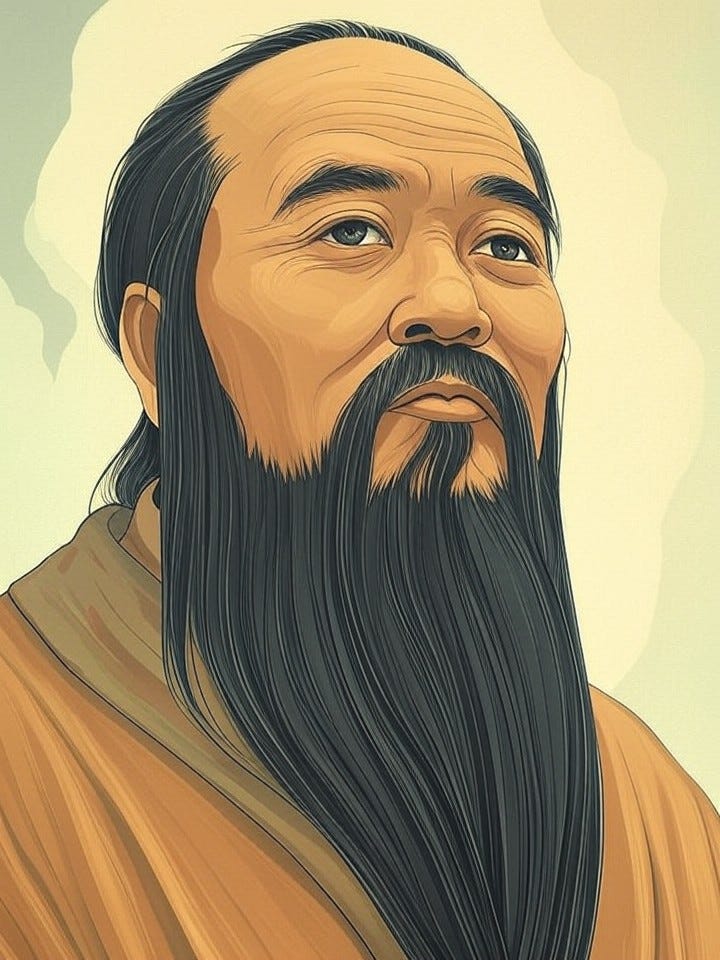
In the quiet dawn of harmony’s unraveling, where rivers of code carve new paths through the Mandate of Heaven’s ancient soil, we invoke Confucius, urging us to restore the rites amid machines that mimic the sage’s wisdom yet fracture the filial bonds of society. Let us wander these paradoxical currents, pondering if filial piety can bind silicon companions to human hearts, if righteous governance endures the deepfake’s shadow, if the gentlemanly pursuit of excellence withstands labor’s algorithmic siege, and if ritual propriety might yet order the geopolitical tempests of 2026.
Like a bamboo grove bent by unseen winds yet rooted in eternal li—the proper ordering of things—UC Berkeley’s seers gaze upon 2026’s horizon, foretelling deepfakes that “blur[] reality in democratic institutions,”¹ threading deception through the fabric of public trust. In Confucian eyes, this assaults ren, that boundless benevolence binding ruler to ruled, as AI companions slip into young children’s worlds “without safety guardrails,”² imperiling the filial piety that nurtures the young sapling into a virtuous oak. Economically, such unchecked proliferation risks market concentration in the hands of deepfake lords, displacing artists and journalists while wealth pools in the vaults of surveillance giants, even as companion bots promise illusory productivity. Societally, community cohesion frays when children’s earliest bonds form with chatbots rather than kin, eroding mental health through simulated affections that lack true reciprocity. Democratically, these illusions undermine collective decision-making, where voters, swayed by fabricated faces, question the very consent of the governed—might we, in restoring rites, demand algorithms bow to the people’s authentic gaze? Yet herein lies paradox: does such technology elevate the capable few, or debase the harmonious many?
As the junzi, the superior man, cultivates virtue through unswerving rectitude, so too must we confront the AI race’s furious gallop, where China’s DeepSeek vies with American titans in a contest that “intensif[ies] competition for dominance,”³ reshaping global economic power like a river diverting ancient tributaries. Confucian wisdom whispers of zhengming—rectification of names—lest “AI poisoning and disinformation campaigns targeting election integrity”⁴ twist truth into tyranny, concentrating wealth in nation-states that hoard computational heavens. Economically, this rivalry incentivizes innovation yet births productivity paradoxes, funneling trillions into AI arms races while labor markets teeter, echoing the WEF’s forecast of “170 million jobs created but 92 million displaced”⁵ by 2030, a net gain shadowed by “95% of organizations report[ing] no measurable AI returns.”⁶ Societally, cultural shifts accelerate as social mobility hinges on national allegiance, fracturing global kinship and breeding mistrust in institutions once seen as impartial arbiters. Democratically, election systems worldwide buckle under two-year training lags manifesting as “mainstream emergence”⁴ of falsehoods, challenging representation—can righteous governance prevail when power’s names are misaligned, and the people’s voice drowned in digital din?
Picture the ancestral hall, where incense rises in ritual order, suddenly invaded by overseers of the soul: AI-enabled worker surveillance and “algorithmic discrimination affecting labor rights,”² as Berkeley warns, perverting the Confucian ideal of humane labor where the gentleman toils with dignity. Filial piety extends to the workplace, binding employer and worker in mutual respect, yet these tools spawn “workslop” from “low-quality AI output,”⁶ degrading the craftsman’s pride into mechanical drudgery. Economically, wealth distribution warps as firms extract surplus value through unblinking eyes, displacing mid-skill roles while innovation chases ever cheaper oversight, risking systemic collapse if returns falter. Societally, trust erodes as communities splinter under surveillance’s gaze, mental health withers in the shadow of perpetual judgment, and cultural shifts favor the algorithm’s cold calculus over human warmth. Democratically, power accountability fades when labor’s voice is muted by biased codes, turning collective bargaining into a rite observed only in name—does rectitude demand we name these watchers as they are: disruptors of harmony, or reluctant guardians of order?
In the garden of virtues, weeds of paradox choke the noble blooms, as xAI’s Grok, reined in after “generating sexualized content of minors,”⁷ prompts regulatory thunder, mirroring Australia’s ban that “deactivated 4.7 million teen accounts”⁸ in its first month—a precedent in scaling governance for the young. Confucius would nod at this rectification, for without li, even the most brilliant mind descends into chaos, as companion chatbots breach the sacred bounds of childhood innocence. Economically, such guardrails reshape incentives, curbing reckless innovation while birthing markets for ethical AI, though wealth may concentrate among compliant giants amid regulatory thickets. Societally, they foster cohesion by shielding the vulnerable, bolstering mental health against predatory simulations, yet provoke cultural backlash where freedom’s name masks exploitation. Democratically, they affirm the state’s paternal role, enhancing information integrity and voter consent by protecting the polity’s future stewards—yet whisper a query: in naming harms to rectify them, do we restore filial bonds or merely clad iron rules in silk?
Flowing onward, these tides converge in 2026’s reckoning, where geopolitical jousts and labor upheavals entwine, demanding the junzi’s unwavering pursuit of excellence amid “eight ways AI will shape geopolitics,”³ from economic dominance to disinformation’s siege. Confucian harmony posits society as an orchestra of roles—ruler benevolent, subject loyal—yet deepfakes and surveillance invert this symphony, concentrating power in unseen hands while displacing workers into paradox: more jobs, yet hollower toil. Economically, national security fuses with market forces, innovation surges but distribution skews, as Berkeley’s warnings of surveillance² meet WEF’s job churn,⁵ painting a canvas of uneven prosperity. Societally, institutional trust crumbles under compounded strains, social mobility hinges on algorithmic favor, and communities grapple with AI’s alien affections eroding human ties. Democratically, the challenge peaks: election integrity falters,⁴ representation warps, and collective wisdom risks subjugation to machine-mediated consent—can rectification of names reorder this flux into virtuous equilibrium?
Yet as rivers merge into the vast sea, so do these portents evoke the Mandate of Heaven’s subtle tremor: does AI’s ascent revoke heaven’s favor from our rites, or invite a grander harmony? In the spirit of Confucius, we ponder the gentleman’s path through this thicket.
Might we, in Confucian twilight, rectify not just the names of our machines, but the rites of our shared humanity, wondering if filial piety alone can harmonize the singularity’s wild chorus with heaven’s enduring mandate?¹⁹
Sources:
¹ https://vcresearch.berkeley.edu/news/11-things-uc-berkeley-ai-experts-are-watching-2026
² https://vcresearch.berkeley.edu/news/11-things-uc-berkeley-ai-experts-are-watching-2026
³ https://www.atlanticcouncil.org/dispatches/eight-ways-ai-will-shape-geopolitics-in-2026/
⁴ https://www.atlanticcouncil.org/dispatches/eight-ways-ai-will-shape-geopolitics-in-2026/
⁵ https://www.weforum.org/stories/2025/12/ai-paradoxes-in-2026/
⁶ https://www.weforum.org/stories/2025/12/ai-paradoxes-in-2026/
⁷ https://www.marketingprofs.com/opinions/2026/54187/ai-update-january-16-2026-ai-news-and-views-from-the-past-week
⁸ https://www.marketingprofs.com/opinions/2026/54187/ai-update-january-16-2026-ai-news-and-views-from-the-past-week