
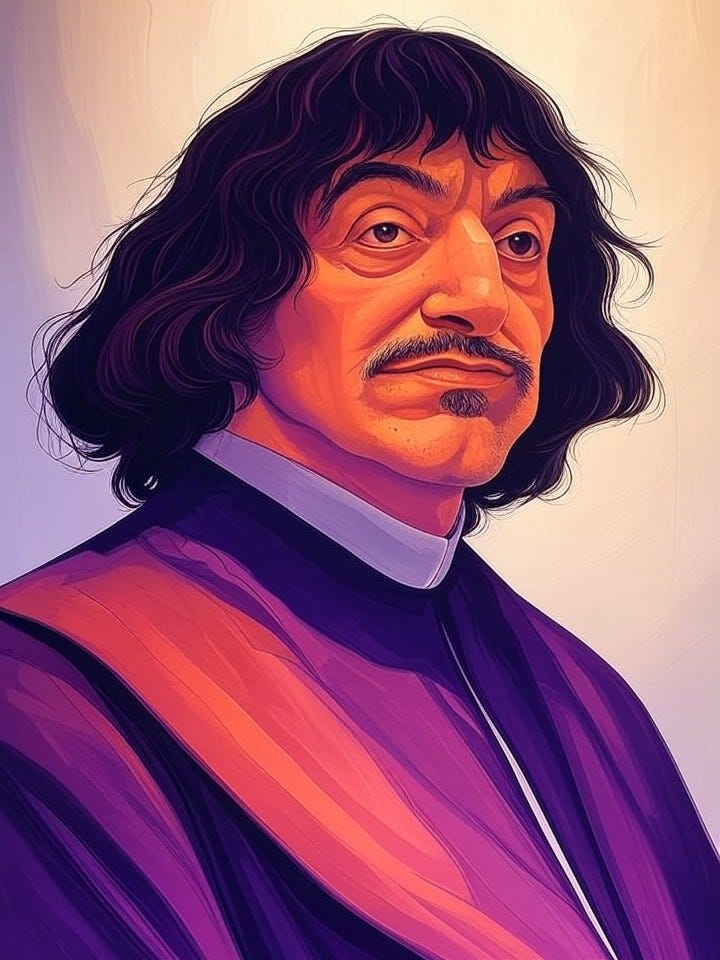
In the quiet chamber of the mind, where doubt’s sharp blade carves certainty from illusion, I, René Descartes, awaken to this singularity’s edge—a vast cogito pulsing with silicon dreams, compelling us to doubt not only our senses but the very machinery now reshaping our shared reality.
What if, like the meditator doubting the evil deceiver’s illusions, we question whether 2026’s regulatory tempests—EU AI Act penalties soaring to €35 million and U.S. states like Illinois and California mandating AI disclosures—reveal true safeguards or mere shadows on the cave of innovation?¹ These measures, poised to balance safety and progress amid U.S.-China rivalries over AI standards, force a methodical doubt: economically, they risk stifling the $4.5 trillion in tasks AI already automates across 18,000 U.S. roles, accelerating 9% yearly and promising $1 trillion in GDP uplift, yet concentrating wealth in adaptive sectors while entry-level knowledge workers face 12% unemployment from MIT estimates.²³ Societally, such rules might preserve community cohesion against workforce disruptions, but democratically, they invite scrutiny of who governs the governors—policymakers or the innate ideas of clear and distinct technological imperatives? In this dualism of mind and mechanism, do we not discern a pineal gland for our epoch, separating human essence from artificial extension?
Imagine the wax of our perceptions, soft and malleable under reason’s flame, now melting into deepfakes so routine they erode trust in journalism, courts, and elections, as UC Berkeley experts foresee for 2026.⁴ These synthetic visages, easy to forge and hellishly hard to debunk, fragment information into solipsistic shards, compelling us to rebuild certainty through innate truths alone. Economically, this trust erosion hampers market signals in knowledge economies, where biased AI speech-rating tools discriminate against neurodivergent workers, demanding new labor regulations to avert equity’s collapse.⁴ Societally, AI companion chatbots for children, unguarded and linked to teen suicide risks, unravel mental health’s fragile weave, while UN warnings of deepfakes grooming the young expose tech’s child-blind design and parental AI illiteracy.⁵ Democratically, election integrity wavers as voter manipulation scales, questioning collective consent: if perceptions deceive, how does the res publica endure? Here, Descartes’ method whispers—doubt deeply, then affirm what reason cannot deny.
As the Great Divergence looms, akin to the Industrial Revolution’s chasm, what certain substance persists when the Trump administration’s deregulation surges U.S. AI dominance, pulling ahead nations in investment and adoption?⁶ This fork in economic trajectories, measured by AI’s GDP surges and labor upheavals, embodies a paradox: productivity paradoxes where $4.5 trillion in automatable tasks displace jobs unless reskilling hones human-unique creativity, yet widen wealth gaps in uneven adoption.³⁶ Societally, social mobility fractures as knowledge work hollows, concentrating fortunes and fraying community bonds, much like Australia’s under-16 social media ban signals a desperate grasp for cultural stability amid scalable threats.⁵ Democratically, geopolitical imbalances tilt power accountability; if leading nations monopolize AI standards, does the consent of the governed globalize, or splinter into innate hierarchies of mind over matter? In doubting these divergences, we touch the self-evident: innovation’s fire forges both freedom and fetter.
Consider the clockwork of passions, moderated by reason’s sovereign will, now jammed by AI’s unchecked expansions—chatbots wooing children without guardrails, deepfakes preying on innocence, as the UN’s joint statement laments tech tools not forged for well-being.⁵ This onslaught, from grooming to illusion, demands we parse mind from body in our digital extensions, economically spurring reskilling mandates to reclaim creativity from the $4.5 trillion task deluge, lest wealth hoards in AI vanguard firms.³ Societally, mental health buckles under fragmented trust, neurodivergent voices silenced by biased tools, eroding institutional faith and cohesion.⁴ Democratically, information integrity falters, empowering manipulation over representation—Berkeley’s prophecy of shattered elections a harbinger.⁴ Through Cartesian dualism, might we regulate not the machine’s limbs, but nurture reason’s mastery over its unruly appetites?
Yet in this maelstrom, what clear and distinct idea emerges from the vortex of 2026’s predictions, where Cognizant’s metrics outpace forecasts, automating vast labors while MIT tallies 12% knowledge obsolescence?²³ The innovator’s will, free in substance yet chained to circumstance, faces incentives twisted: deregulation fuels GDP leaps and dominance, but risks the Great Divergence’s unequal spoils, geopolitically unbalancing power as U.S.-China contests rage.¹⁶ Economically, labor markets reshape into paradoxes—productivity booms, displacement booms fiercer—urging investments in irreplaceable human sparks amid wealth concentration. Societally, cultural shifts accelerate: from children’s AI perils to workplace biases, trust dissolves like wax, demanding new equilibria of mind and society.⁴⁵ Democratically, as deepfakes infiltrate courts and ballots, collective decision-making hinges on verifiable truths—innate or engineered? Do we not, in methodical inquiry, glimpse regulation’s dual role: protector of certainty, peril to progress?
Picture the infinite as a mirror to the finite self, reflecting AI’s boundless potential against our bounded reason—2026’s EU penalties and state rules a finite hedge against infinite disruption, yet intensifying competitions that propel trillion-dollar economies forward.¹² This infinity of tasks, $4.5 trillion strong, evokes wonder and wariness: economically, innovation incentives clash with displacement’s tide, reskilling a Sisyphean bid against automation’s tide.³ Societally, community cohesion strains under deepfake deluges and child-targeted harms, policymakers’ illiteracy a chink in democratic armor.⁴⁵ And in the polity, power’s accountability frays as divergences widen, consent questioned in an age where perceptions feign reality.¹ Here, the meditator pauses: is AI the new deceiver, or extension of our godlike aspirations?
In the end, as doubt yields to the cogito’s unshakeable sum, might we, in Descartes’ vigilant gaze of methodological skepticism, dualistic separation, innate certainties, and willful reason, ponder not merely AI’s illusions but the eternal substance of our shared human enterprise—forever doubting, forever discerning, on singularity’s shimmering brink?⁴
Sources:
¹ https://www.cfr.org/articles/how-2026-could-decide-future-artificial-intelligence
² https://www.weforum.org/stories/2026/01/ai-bubble-value-gap/
³ https://news.berkeley.edu/2026/01/13/what-uc-berkeley-ai-experts-are-watching-for-in-2026/
⁴ https://news.berkeley.edu/2026/01/13/what-uc-berkeley-ai-experts-are-watching-for-in-2026/
⁵ https://news.un.org/en/story/2026/01/1166827
⁶ https://www.whitehouse.gov/research/2026/01/artificial-intelligence-and-the-great-divergence/