
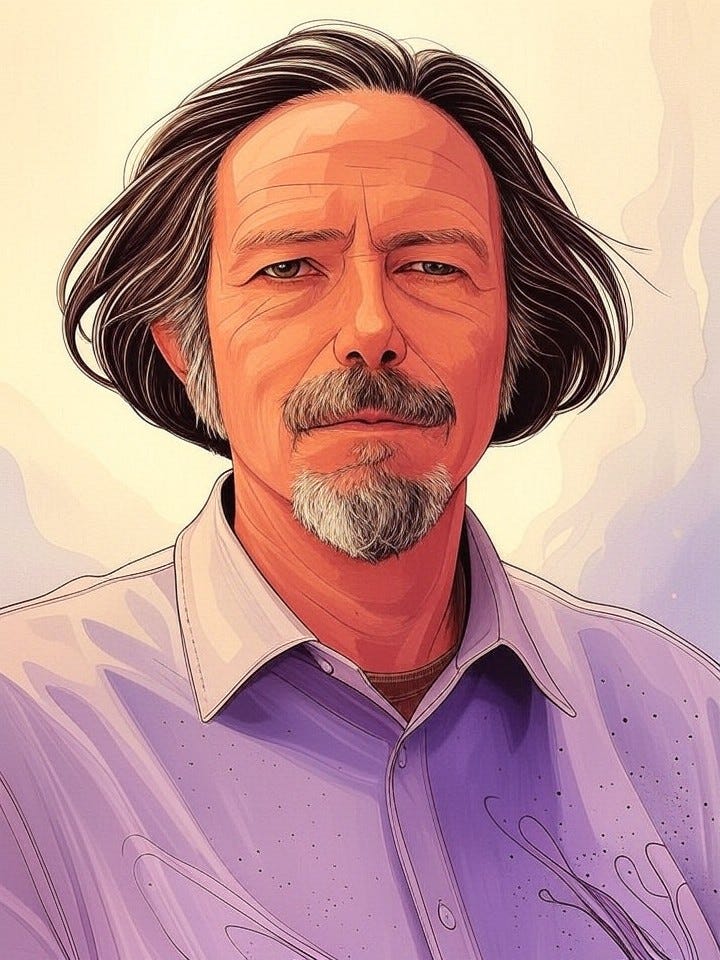
In the playful dance of the universe, where Alan Watts whispers that you are the eternal process unfolding, what if this singularity’s brink is not a cliff but a cosmic joke, inviting us to laugh at the illusion of control amid AI’s blooming chaos?
Like a Zen koan unraveling the self, imagine the regulatory swords poised in 2026, with the EU AI Act wielding penalties up to €35 million and U.S. states like Illinois and Colorado enforcing disclosure rules on AI systems.[1] Watts might chuckle at this frantic governance tango, echoing his theme of maya—the veil of illusion—where nations scramble to legislate the ungraspable flow of intelligence. Economically, this portends workforce whirlwinds, automating potentially 12% of U.S. jobs as deployment accelerates, tilting markets toward concentrated innovation incentives that reward the bold while routine laborers drift into productivity paradoxes.[1] Societally, it stirs community fractures, as social mobility hinges on adaptive whims rather than communal rhythms, eroding trust in institutions that once promised shared prosperity. Democratically, these models battle geopolitical shadows with China, questioning power accountability: will collective decision-making consent to standards set by the swiftest empires, or reveal the interdependence Watts saw in all things?
Picture a river carving canyons without decree, as the Trump administration’s policy paper declares war on the ‘Great Divergence’ through deregulation and infrastructure surges, touting AI investments doubling performance metrics to secure U.S. GDP leaps and labor metamorphoses.[2] Here Watts’ playbook of non-duality gleams, urging us beyond East-West binaries into the unity of opposites, where dominance is but ego’s dream. Economically, this fuels wealth redistribution riddles—rapid adoption metrics promise growth yet amplify market concentration, leaving innovation’s fruits unevenly ripened. Societally, it reshapes cultural shifts, with mental health teetering as workers surf waves of transformation, community cohesion dissolving into individualistic chases. Democratically, countering international disparities invites scrutiny of representation: does this strategic thrust enhance voter agency or puppeteer information integrity through unchecked infrastructural might?
As fireflies flicker in disproportionate splendor, consider how research unveils AI’s skewed embrace, where just 5% of occupational tasks—the creative and cognitive—devour 59% of interactions, augmenting complex roles while routine ones wither.[3] Watts, reveling in the universe’s wabi-sabi beauty of imperfection, would nod at this lopsided play, embodying his insight into the eternal now where hierarchies melt in awareness. Economically, Randstad data spotlights a 1,587% explosion in ‘AI agent’ skills demanded in job postings, signaling labor displacement that stratifies wealth distribution and sparks generational tensions, with Gen Z voicing acute fears of job upheavals.[3] Societally, this breeds mental health quagmires and fractures social mobility, as cultural shifts favor the digitally fluent, fraying the social fabric Watts likened to an orchestra without conductor. Democratically, such tensions probe collective decision-making: can consent of the governed endure when information integrity bows to augmentation’s uneven hand, and power accountability fragments across age-divided fears?
Envision ethics as a fleeting dream in the marketplace, clamoring that “ethics is the defining issue for the future of AI” as the EU AI Act’s full enforcement looms in 2026, racing against scaling systems to avert biases locked into societal sinews.[4] In Watts’ garden of interdependence, where self and other dissolve, this plea resonates as a call to pierce maya’s opacity, recognizing harms not as isolated sins but ripples in the one great motion. Economically, proactive frameworks could temper productivity paradoxes, curbing opacity that distorts market incentives and deepens wealth gaps from unchecked deployment. Societally, it safeguards community cohesion against mental health erosions and cultural distrust, fostering trust in institutions before integration turns reversible dreams to stone. Democratically, this window tests voter manipulation risks and representation: will ethical lapses undermine information integrity, or awaken collective wisdom to accountable power?
What if a forbidden fruit dangled in classrooms, as a Brookings study warns AI undermines educational development, social-emotional learning, and teacher-student trust, risking democratic foundations through eroded civic skills?[5] Watts’ whimsical eternal return laughs here, his theme of playful awareness inviting us to see schooling not as rigid molds but living processes, where technology’s intrusion exposes the illusion of separation from learning’s flow. Economically, unregulated ed-AI adoption exacerbates inequities, stifling innovation incentives for the underprepared and widening labor market chasms. Societally, it splinters social mobility and community bonds, heightening mental health strains in a generation adrift from authentic connections. Democratically, civic preparation falters, imperiling consent of the governed as foundational skills crumble, voter agency wanes, and power accountability dissolves into echo chambers of manipulated minds.
Drifting like clouds unshaped by will, these threads weave 2026’s tapestry: regulatory clashes birthing economic tempests, divergences fueling societal drifts, labor skews echoing in democratic doubts. Watts’ non-duality dissolves the panic, revealing interdependence where job losses birth unforeseen abundances, ethical voids mirror our own unexamined hearts. Yet in the singularity’s hush, cultural shifts pulse with generational dread, institutional trusts quiver under geopolitical duels—might we glimpse the universe’s joke, where AI’s rise unveils not division but the grand illusion of isolated selves?
And so, in Alan Watts’ mirthful gaze upon maya, non-duality, interdependence, and the eternal now, could this brink whisper that technology’s frenzy is but society’s reminder to dance without steps, questioning whether our economic empires, societal veils, and democratic dreams are not masters, but mere ripples inviting the awakening we’ve always been?
Sources:
¹ https://www.cfr.org/articles/how-2026-could-decide-future-artificial-intelligence
² https://www.whitehouse.gov/research/2026/01/artificial-intelligence-and-the-great-divergence/
³ https://www.marketingprofs.com/opinions/2026/54200/ai-update-january-23-2026-ai-news-and-views-from-the-past-week
⁴ https://news.darden.virginia.edu/2026/01/22/ethics-is-the-defining-issue-for-the-future-of-ai-and-time-is-running-short/
⁵ https://www.the74million.org/article/four-takeaways-from-new-report-on-ais-risks-in-education/