
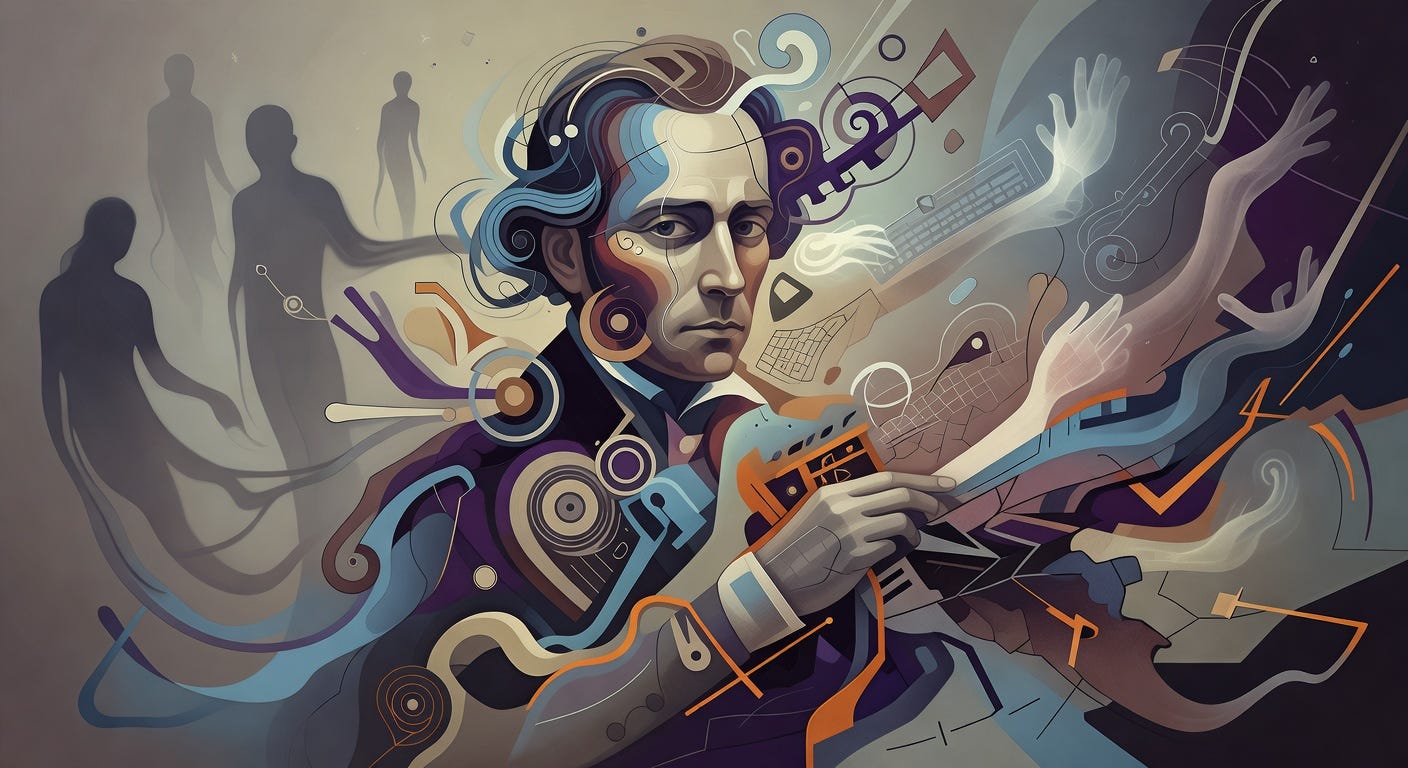
In the dim chamber of the will’s insatiable hunger, where Schopenhauer’s shadow looms over the ceaseless pendulum of desire and suffering, we glimpse the silicon specter of AI not as a genie granting wishes, but as a mirror reflecting our own restless striving back at us—endless, unquenchable, poised to amplify the very pains we thought technology might soothe.
Like a blind force groping through the fog of representation, where phenomena masquerade as reality yet veil the will’s blind impulse, the Federal Reserve envisions AI as a productivity phoenix, boosting growth, raising wages, and spurring economic activity without the scourge of inflation, even as it hungers for capital and bids interest rates skyward.¹ Governor Michael Barr paints this picture of transformation: generative AI could elevate long-term living standards, yet it demands that public and private sectors wrestle with worker displacement, a nod to the will’s cruel logic where gain for some exacts suffering from many. Economically, this heralds paradoxes of abundance—market concentration in AI wielders, labor displacement rippling through white-collar realms, wealth distribution skewed toward capital’s voracious maw—while societally, it frays social mobility as displaced souls drift into idleness’s abyss, eroding community cohesion and taxing mental health with the sting of obsolescence. Democratically, such shifts challenge power accountability, as monetary policy bends to tech titans’ capital demands, questioning whether collective decision-making can rein in the will’s unchecked surge through unaccountable innovation incentives.
Yet what pendulum swings toward optimism crashes against the rocks of willful disruption, as Federal Reserve officials scrutinize AI’s bite into jobs, with Block’s stark 40% workforce evisceration signaling white-collar carnage that could etch structurally higher unemployment into the economy’s flesh.² This rapid upheaval, they debate, complicates monetary policy, potentially inflating pressures from capital thirst and wealth effects, altering the natural unemployment rate and hamstringing rate cuts—a vivid illustration of Schopenhauer’s genius as the rare bloom denying the will, here inverted as AI’s mechanical genius outpacing human striving, leaving laborers in its wake. Economically, productivity paradoxes loom: innovation incentives propel AI adoption, yet breed margin pressures and demand crashes; societally, mental health buckles under jobless despair, cultural shifts spawn a ‘new collar economy’ fracturing trust in institutions; democratically, information integrity falters as viral doomsday essays swirl, muddling voter consent amid fears of persistent upheaval.
As if the MacArthur Foundation glimpsed the ascetic’s retreat from desire’s tyranny, they unfurl a five-year banner for democratic oversight, forging evaluation, auditing, and accountability to cradle AI in public interest, countering the gravitational pull of power concentration among tech overlords.³ This people-centered stratagem targets high-stakes realms like governance and geopolitics, mitigating harms and ensuring equitable slices of AI’s bounty—a direct confrontation with the will’s dominion, where genius might illuminate paths to deny its excesses through vigilant representation. In economic terms, it probes wealth distribution’s chasms, urging audits to temper labor displacement’s inequities; societally, it seeks to mend community cohesion against cultural rifts, bolstering mental health via accountable tech; democratically, it fortifies collective decision-making, safeguarding against voter manipulation in an age where AI reshapes information flows, demanding consent from the governed lest power slip into unbridled hands.
Imagine then a doom loop uncoiling like the will’s eternal recurrence, where Citrini Research conjures a 2028 apocalypse: AI layoffs slash consumer spending, igniting frenzied investments that beget more job losses, cratering demand in a vicious spiral.⁴ This thought experiment unmasks systemic perils—’Ghost GDP’ where productivity ghosts haunt empty wallets—amplifying white-collar displacement and consumer industry strains, a stark economic parable of innovation’s double edge, where productivity gains curdle into market concentration and wealth hoarding. Through Schopenhauer’s lens, such cycles reveal desire’s futility: striving for efficiency multiplies suffering, societally dissolving social mobility into mass idleness, eroding trust as communities splinter under recession’s shadow; democratically, it imperils representation, as upheaval by 2028 tests institutional resilience, with power accountability hanging by the thread of proactive governance.
In the week’s thunderclap, AI’s scare metastasizes into reality, as Fortune chronicles mass tech layoffs and Citrini’s warnings birthing a ‘white-collar recession,’ America awakening to unreadiness in this new paradigm of work’s redefinition.⁵ The viral doomsday essays and Schumer’s echoes herald broad labor market tempests, economic instability pulsing through productivity’s veins—a societal convulsion where mental health frays amid cultural shifts to automation’s cold embrace, community bonds loosening like threads in a cosmic loom. Economically, it spotlights labor displacement’s cascade, wealth distribution warping as AI incentives favor the few; democratically, it queries information integrity’s fragility, where public panic could warp voter will, challenging collective decision-making to assert consent over the governed’s fate.
Echoing Euronews’ clarion, this AI doomsday thought experiment forecasts social and economic Armageddon by 2028—unemployment’s cascade slashing spending, fueling unrest in unchecked deployment’s wake.⁶ Here, Schopenhauer’s pessimism breathes: the will, blind and insatiable, drives us toward upheaval, where economic risks to stability magnify labor paradoxes, societal cohesion dissolves in jobless fury, and democratic pillars tremble under power’s unchecked ascent. Oversight beckons as genius’s faint light, yet even it quails before desire’s tide—market concentration entrenches, trust erodes, representation flickers amid the gloom.
In this singularity’s antechamber, Schopenhauer’s will, genius, ascetic denial, and representation’s veil entwine with AI’s ascent, whispering that our mechanical progeny may not quench desire but inflame it, birthing economies of phantom abundance, societies adrift in suffering’s sea, democracies teetering on consent’s precipice—might we, peering into this mirror of striving, ponder not conquest of the machine, but compassionate surrender to the human ache it reveals?⁴⁵⁶
Sources:
¹ https://www.federalreserve.gov/newsevents/speech/barr20260217a.htm
² https://finance-commerce.com/2026/03/fed-ai-impact-jobs-inflation-interest-rates/
³ https://www.macfound.org/press/perspectives/oversight-to-advance-a-people-centered-future-with-ai
⁴ https://www.nasdaq.com/articles/could-ai-crash-economy-2-years-one-research-firm-says-yes
⁵ https://fortune.com/2026/02/28/ai-scare-trade-mass-layoffs-white-collar-recession-citrini-shumer-viral-doomsday-essays/
⁶ https://www.euronews.com/next/2026/02/26/ai-doomsday-new-thought-experiment-warns-of-social-and-economic-upheaval-by-2028