
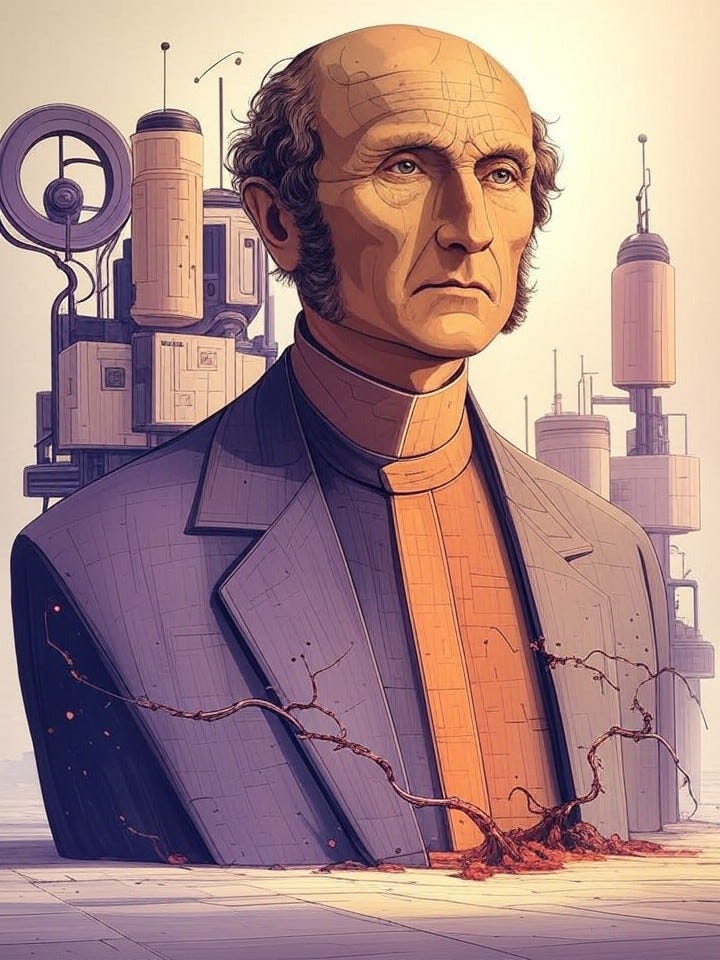
In the quiet liberty of a mind unchained, where John Stuart Mill once wandered the gardens of utility and truth, we stand on 2026’s threshold—a singularity not of stars collapsing, but of human potential fracturing into code and choice. What gentle breezes of progress might carry us to higher happiness, or whirl us into tempests of unintended woe?
Like a vast millwheel turning inexorably, grinding the familiar flour of labor into unfamiliar dust, AI in 2026 promises to automate 12% of U.S. jobs cost-effectively, as MIT foresees, displacing workers in waves that ripple through economies like shadows fleeing dawn.¹ Through Mill’s lens of utilitarianism, we ponder: does this churn maximize the greatest happiness for the greatest number, or does it tilt the scales toward a privileged few, exacerbating inequality without reskilling’s timely hand? Economically, it births productivity paradoxes—innovation surges as machines toil without fatigue, yet market concentration swells, with wealth distribution warping like a funhouse mirror. Societally, social mobility stutters, communities fray as blue-collar bonds dissolve into gig precarity, and mental health frays under the anxiety of obsolescence. Democratically, the consent of the governed strains when displaced voters, adrift in economic limbo, question representation in halls echoing with tech titans’ voices. Mill’s harm principle whispers caution: shall we permit this displacement if it harms the many without liberty’s safeguard?
Yet what if the river of regulation, dammed by competing nations, forks into channels of governance or chaos, as 2026 emerges as the decisive year for AI’s fate in U.S.-China rivalry?² Colorado’s AI Act and the EU’s looming benchmark aim to bridle workforce disruptions, shaping frameworks for trillions in economic activity. Mill, champion of individual liberty, would interrogate: does such state-level meddling enhance utility by preventing harm, or stifle the free market’s experimental vigor? Economically, it risks innovation incentives dimming under regulatory fog, while productivity paradoxes deepen—deregulated booms versus cautious growth. Societally, cultural shifts accelerate, with trust in institutions teetering as opacity breeds suspicion; community cohesion splinters if global standards favor one superpower’s ethic over another’s. Democratically, power accountability hinges on collective decision-making: can voters discern true progress from manipulated narratives in an AI-augmented arena? Here, Mill’s fourfold liberty test beckons—over one’s self, tastes, associations, and speech—urging us to weigh if governance liberates or encroaches.
Imagine a grand divergence, not of roads in yellow woods, but of empires forged in silicon revolutions, where deregulation and infrastructure propel U.S. AI dominance, mirroring the Industrial Revolution’s great leap.³ Trump’s strategy tracks metrics of investment and adoption to widen global economic chasms, boosting GDP yet concentrating wealth like rivers carving canyons. From Mill’s utilitarian heights, we ask whimsically: does this divergence elevate aggregate happiness, or does it harm the distant many through geopolitical tremors? Economically, labor displacement accelerates, innovation incentives flare in deregulated fires, but wealth distribution polarizes into haves and have-nots. Societally, social mobility cascades unevenly, mental health buckles under inequality’s weight, and cultural shifts enthrone tech as new aristocracy, eroding community trust. Democratically, representation falters as power concentrates, voter manipulation lurks in unchecked AI tools, and information integrity wavers—echoing Mill’s plea for free inquiry to combat the despotism of custom. Liberty, that fragile bloom, wilts if divergence denies the governed their say in fate’s forge.
As ethics races a hare to the governance tortoise, with time’s sands slipping through 2026’s hourglass, the EU AI Act stands as sentinel against bias and opacity in critical systems.⁴ Mill, ever the ethical architect, would muse: can utility flourish without frameworks that prevent societal harms locked in for decades? Economically, failure invites productivity paradoxes where biased algorithms hoard gains for the few, stifling broad innovation. Societally, labor fairness crumbles, democratic trust erodes like cliffs to the sea, and institutional stability quakes amid cultural rifts. Democratically, collective decision-making frays if opacity shields power from accountability, turning consent into illusion. Whimsically, picture Mill at tea with the singularity: does harm principle demand we pause scaling, lest liberty drown in ethical voids?
What kaleidoscope of perils spins before experts’ eyes in 2026—labor disruptions, deepfakes devouring truth, investment bubbles swelling like overripe fruit?⁵ UC watchers foresee workforces reshaped, elections shadowed, financial systems teetering, all threatening social stability. Mill’s pursuit of truth through open debate illuminates: utility demands we confront these not with censorship, but vigorous inquiry. Economically, bubbles burst productivity’s promise, market concentration festers, wealth gaps yawn. Societally, community cohesion unravels as deepfakes fracture trust, mental health plummets in truth’s barren fields, cultural shifts warp reality itself. Democratically, voter manipulation surges, information integrity crumbles, power’s accountability dissolves—challenging Mill’s faith in the marketplace of ideas, where free expression forges collective wisdom.
In democracy’s agora, now humming with AI’s siren’s song, how does the machine both illuminate paths to better information and lure us into manipulation’s lair?⁶ Leiden’s gaze reveals dual blades: strengthened participation via access, yet deepened divides in trust and decision-making. Mill, defender of free speech as truth’s crucible, would probe poetically: does this duality harm liberty’s exercise, or hone it? Economically, it alters labor markets indirectly, as manipulated publics skew policy toward inequality. Societally, social mobility hinges on trusted info-flows, community bonds strain under false narratives, cultural shifts redefine consensus. Democratically, election integrity teeters, representation dilutes in echo chambers, consent fractures—paradoxically mirroring Mill’s paradox of liberty versus tyranny of the majority amplified by algorithms.
As these threads weave 2026’s tapestry—automation’s scythe, regulation’s reins, divergence’s fork, ethics’ cry, perils’ parade, democracy’s dance—Mill’s spirit bids us dance lightly, questioning utility without chains. Might we, in the utilitarian garden of endless experimentation, discover that true liberty blooms not in AI’s shadow alone, but in the free minds daring to cultivate it amid singularity’s wild blooms?
Sources:
¹ https://mitsloan.mit.edu/ideas-made-to-matter/looking-ahead-ai-and-work-2026
² https://www.cfr.org/articles/how-2026-could-decide-future-artificial-intelligence
³ https://www.whitehouse.gov/research/2026/01/artificial-intelligence-and-the-great-divergence/
⁴ https://news.darden.virginia.edu/2026/01/22/ethics-is-the-defining-issue-for-the-future-of-ai-and-time-is-running-short/
⁵ https://www.universityofcalifornia.edu/news/11-things-ai-experts-are-watching-2026
⁶ https://www.staff.universiteitleiden.nl/news/2026/01/how-does-artificial-intelligence-influence-democratic-processes