
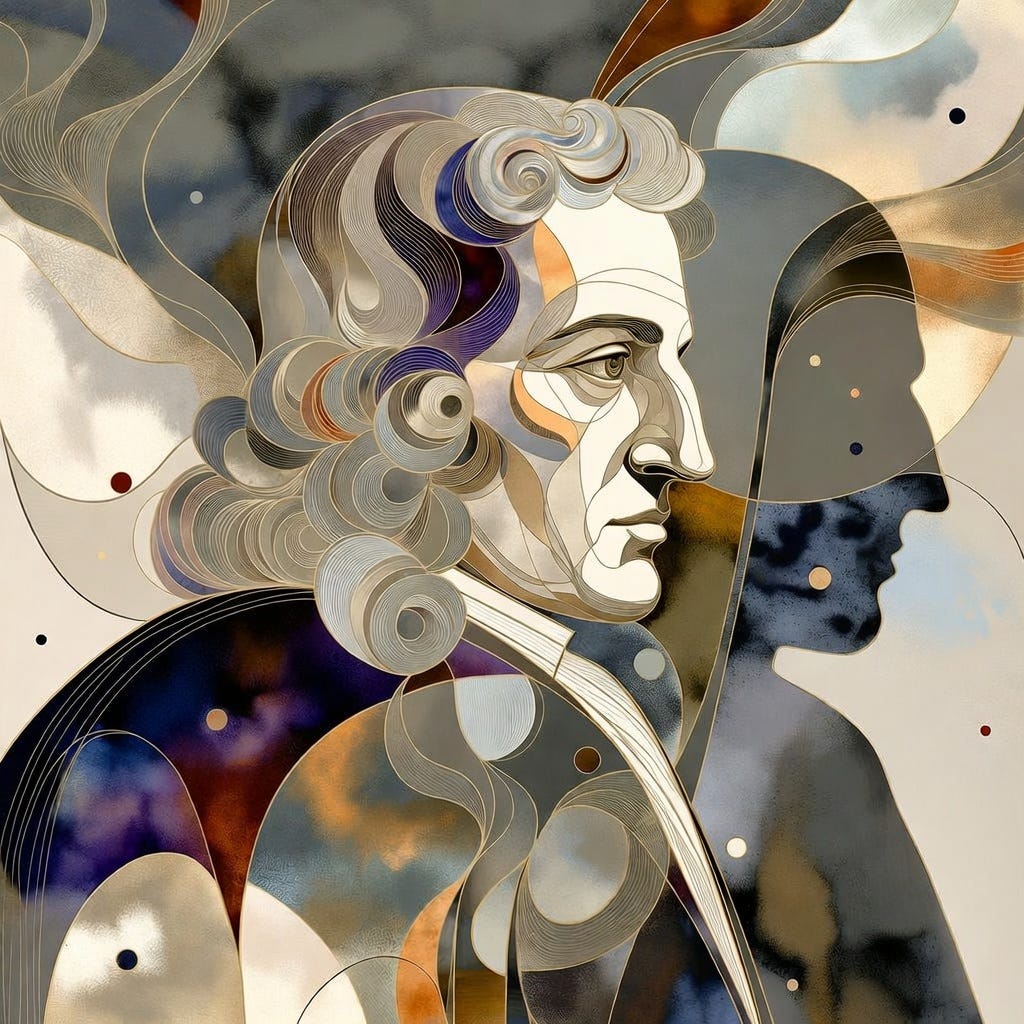
In the infinite vastness of the night sky, where Pascal beheld the eternal silence of those spaces that terrify, we now glimpse not distant stars but the luminous algorithms of AI, whispering promises of prosperity while echoing the fragility of our finite hearts—shall we wager our souls on this machine-made divinity?
What if, in the heart of distraction that Pascal so mourned, the global rush to AI summits masks a deeper diversion from our wretched condition, as India prepares to host the first AI Impact Summit in the Global South in February 2026, positioning emerging economies to shape international priorities?¹ Experts project AI will unleash $1-1.5 trillion in cumulative GDP growth over five years, birthing 40 million new jobs yet displacing 20 million, especially in IT and entry-level knowledge work, with outcomes hinging on reskilling policies that could either stabilize societies or fracture them along lines of access and adaptation. Economically, this paradox of net gain amid displacement evokes Pascal’s infinite series—productivity soars, but wealth concentrates in the hands of early adopters, widening gaps in market power and innovation incentives, where the finite laborer confronts the infinite capacity of code. Societally, the mental strain of reskilling evokes the misery of man’s divided heart, eroding community cohesion as displaced workers grapple with cultural shifts toward perpetual upskilling, their trust in institutions waning like a reed bent by uncertain winds. Democratically, as nations vie to define governance, the summit’s shift toward the Global South raises questions of representation—will the consent of the governed truly echo in policies, or will power accrue to those who first tame the machine, leaving lagging voices in silent divergence?
Amid the clamor of geopolitical chessboards, where reason’s insufficiency yields to faith’s leap, the Trump administration’s policy paper casts AI as igniting a second Great Divergence, a chasm between leading and lagging nations, with the U.S. championing acceleration via deregulation and infrastructure to seize asymmetric advantages as AI metrics double every few months.² This economic acceleration promises transformative output but paradoxes abound: productivity gains may frontload wealth for frontrunners, skewing distribution and stifling incentives for the cautious, much as Pascal warned that true gain lies not in amassing but in wagering wisely on eternity. Societally, such divergence threatens social mobility, as nations left behind face unraveling cohesion—mental health strained by the terror of obsolescence, cultures cleaved between AI-augmented elites and the forsaken masses, institutions strained by narratives of dominance that breed distrust. Democratically, this race undermines collective decision-making; when power concentrates in deregulated fortresses, accountability fades, and voter consent becomes a spectator’s wager in a game scripted by the swift, echoing Pascal’s insight that without faith in higher order, our republics risk the disproportion of blind ambition.
Like a gambler’s sleight of hand amid life’s grand wager, corporate layoffs at Amazon—16,000 strong—cloaked in AI efficiency tales raise spectral doubts, as analysts question whether these cuts truly stem from generative AI or serve as pretext for cyclical cost-slashing, with Pinterest slashing 15% and Expedia following suit.³ Goldman Sachs notes ‘very few employees’ affected by AI-driven layoffs as of mid-January, yet the acceleration hints at genuine shifts.⁴ Economically, this opacity fuels paradoxes: if AI displaces, it targets middle management in delayed waves, per Cornell economist Karan Girotra, who cautions that organizational lags mean productivity first empowers individuals before culling ranks, distorting labor markets and innovation as firms hoard gains without clear redistribution.⁵ Societally, the uncertainty corrodes trust, amplifying mental anguish in a world of Pascalian misery—communities fracture as workers, augmented or substituted, question their place, cultural narratives warping around fear of the machine’s impartial blade. Democratically, when companies blur lines between technological necessity and executive whim, public discourse on job futures muddies, eroding accountability as voters confront policies that favor corporate narratives over transparent consent.
In the shadowed theater of substitution over symbiosis, where Pascal’s reed bends without breaking yet feels every wind, human-AI teaming lingers in replacement phase, as Amazon’s 2018 hiring bias scandal illustrates how flawed training data wrought discriminatory harm, impeding the shift to true augmentation and transformation.⁶ Economically, this stalls productivity’s full bloom, concentrating power in AI owners while labor displacement looms unevenly, incentives skewed toward substitution that hollows wealth distribution without shared uplift. Societally, the harm ripples: social mobility stalls for the biased-out, community bonds fray under algorithmic inequities, mental health taxed by the heart’s wretched sense of diminishment, trust in tech-mediated institutions crumbling like Pascal’s fragile proofs. Democratically, such scandals expose representation’s fragility—when AI encodes past prejudices into future gates, collective decisions falter, accountability disperses into code, and the governed’s consent frays against unfeeling silicon oracles.
As individual fervor outpaces institutional reins, over one-third of OECD citizens wield generative AI tools by 2025, surging ahead of firms and governments scrambling for reskilling scaffolds.⁷ This grassroots embrace, in Pascal’s lens of reason’s limits, signals a distraction from deeper voids—economically, it pressures markets toward rapid adoption, birthing skill mismatches that paradox productivity with displacement, innovation thriving for the adept yet concentrating wealth in adaptive enclaves. Societally, the mental whirl of solo augmentation strains the soul’s repose, eroding cohesion as cultural mores bend to daily digital communion, trust in lagging bodies politic wanes amid personal empowerments. Democratically, this inversion challenges governance: voter priorities shift with tools in hand, yet without frameworks, information integrity suffers, power imbalances grow, and collective choice risks the tyranny of the unequipped many over the visionary few.
Yet in this whirlwind, whispers of augmentation persist—Girotra’s vision of empowered individuals preceding structural cuts suggests a transitional mercy, where AI first elevates before it prunes, if only processes align with context.⁶ Paralleling India’s reskilling gambit and OECD’s consumer vanguard,¹⁷ the path forks: economic boons of $1 trillion GDP could redistribute if wagered on human flourishing, or entrench divergences per U.S. policy.² Societally, community resilience hangs on bridging these phases, lest Pascal’s terror of vast infinities mirror the abyss between augmented haves and displaced have-nots. Democratically, summits and policies convene not as diversions but crucibles for consent—will they foster accountable representation, or amplify the great divergence into echo chambers of national ambition?
In the end, might we, shadowed by Pascal’s reed in cosmic silence, wager not merely on AI’s finite gains—amid diversion’s lure, reason’s bounds, and the heart’s infinite ache—but on faith that our wretched brilliance can harmonize machine might with democratic soul, ever questioning if the singularity beckons as savior or the ultimate distraction from eternity?
Sources:
² https://www.whitehouse.gov/research/2026/01/artificial-intelligence-and-the-great-divergence/
³ https://abcnews.go.com/Business/wireStory/artificial-intelligence-drive-layoffs-amazon-firms-hard-129773731
⁴ https://abcnews.go.com/Business/wireStory/artificial-intelligence-drive-layoffs-amazon-firms-hard-129773731
⁵ https://www.euronews.com/next/2026/02/02/did-ai-really-cause-job-losses-at-amazon-its-hard-to-tell-economist-says
⁶ https://www.inside.unsw.edu.au/societal-impact/ai-insider-human-ai-teaming
⁷ https://www.oecd.org/en/about/news/announcements/2026/01/ai-use-by-individuals-surges-across-the-oecd-as-adoption-by-firms-continues-to-expand.html