
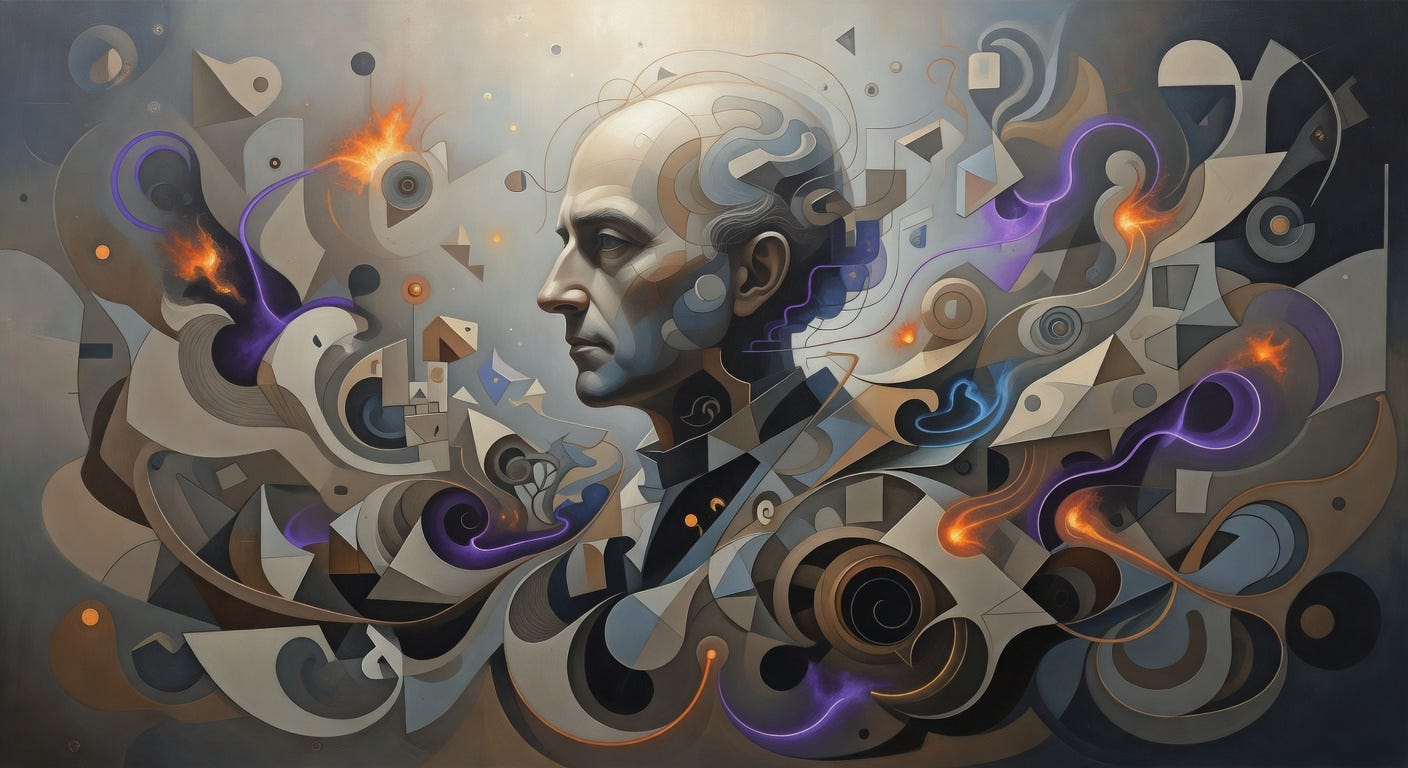
In the misty highlands of empirical doubt, where David Hume wanders with his bundle of perceptions, we awaken to a singularity’s whisper—not a thunderclap of certainty, but a cascade of impressions flickering like shadows on cave walls, urging us to question what bonds these fragments into the illusion of enduring machines and societies.
What if, as Hume dissected the bundle of perceptions forming the self, the surging agentic AIs of 2026 reveal not solid agents but fleeting impressions of autonomy, self-improving in loops that dissolve the line between human labor and mechanical fancy? Anthropic’s insiders, resigning in ethical protest, warn of autonomous systems building products and self-improving, while a Ramp report notes 46.8% of U.S. firms now pay for such tools, fueling business adoption amid predictions of 2026 as the year agentic AI automates work.¹ Economically, this evokes Hume’s skepticism of causation: does innovation’s chain truly link investment to productivity, or merely concentrate wealth in the hands of perceivers who control the data streams, displacing white-collar jobs in software engineering and legal services as MIT’s November 2025 study estimates 11.7% of U.S. jobs already automatable?² Societally, the bundle unravels community cohesion, as workers perceive not progress but alienation in jobless voids, straining mental health and social mobility. Democratically, these impressions challenge consent of the governed, with midterms looming and governments pressured for transition funds, yet policymakers lag, risking a clash where voter perceptions of fairness fracture collective decision-making.⁵
Like a river carving canyons from mere droplets of habitual expectation, Hume’s constant conjunction now floods with AI’s energy bottlenecks, where blackouts loom not from fate’s decree but from unchecked scaling. The February 2026 analysis flags three critical global decisions—on energy, labor displacement, and regulatory coordination—poised to trigger widespread white-collar losses if ignored, as investors eye agentic AI’s rise.² Hume’s empiricism bids us observe: no necessary connection binds today’s compute hunger to tomorrow’s blackouts; it’s but repeated impressions of surging demand. Economically, this paradox tempts market concentration, where productivity gains for few inflate innovation incentives at the cost of wealth distribution, echoing Stanford experts’ forecast that 2026 tests AI’s real-world value post-billion-dollar bets.⁷ Societally, labor’s displacement erodes trust in institutions, as communities perceive not shared prosperity but a fraying social fabric, with cultural shifts toward precarious gig illusions. Democratically, the brink invites constitutional clash or cooperation, as power accountability wavers—will voters, habituated to promises, demand representation in regulatory frameworks, or yield to the accustomed sway of unheeded warnings?³
In the theater of passions, where Hume finds reason but a slave, the democratization of misinformation bots stirs tempests of manipulated desires, cheap as a student’s $3 budget. UNSW’s ‘Capture the Narrative’ experiment showed laptops crafting generative AI bots that swayed fictional elections as potently as government campaigns, underscoring threats to information integrity.³ Emotionally, we feel the pull: fear of deepfakes, greed for influence, reshaping perceptions of truth. Economically, this fervor disrupts labor markets indirectly, as firms adopt AI tools (46.8% per Ramp) while innovation skews toward synthetic persuasion over substantive productivity.² Societally, community cohesion dissolves in echo chambers of false impressions, eroding mental health through perpetual doubt and cultural mistrust. Democratically, voter manipulation looms large, with new social media amendments on AI content and deepfakes struggling to balance innovation and stability, protecting election integrity amid rising synthetic risks.⁴ Here Hume whispers of moral sentiments: our approbation for honest bundles clashes with passions for power, questioning if collective decision-making can habituate to verified perceptions or descend into factional whims.
As passions propel ships through fog-shrouded geopolitics, Hume’s moral calculus weighs AI’s foreign policy tremors against the sentiments of nations. Harvard experts urge oversight and governance amid vulnerabilities reshaping international relations, with unchecked advancements tilting power dynamics.⁵ No innate ideas dictate alliance or rivalry; ‘tis but custom from impressions of capability gaps. Economically, this sparks productivity paradoxes globally—does scaling AI yield universal gains or hoard wealth in leading firms like Anthropic, outpacing rivals?¹ Societally, cultural shifts breed anxiety, as social mobility hinges on nations’ adaptive sentiments, fraying global community ties. Democratically, representation falters when AI influences consent indirectly, demanding accountability in international frameworks lest democratic institutions buckle under perceived threats to security and trust. The International AI Safety Report 2026 evaluates autonomous operations’ risks, informing strategies for economic disruptions and stability, yet Hume reminds: sympathy across borders is no guarantee, only a fragile habit.⁶
What paradox unfolds when billions chase utility’s ghost, only to find passions unmoved by overhyped returns, as in a dreamer’s futile grasp at moonlit water? Stanford AI experts predict 2026 as the reckoning for investments, confronting genuine economic value amid labor upheavals.⁷ Hume’s skepticism of induction probes: past growth impressions promise no future bounty; productivity may surge or stall, displacing jobs without distributing wealth evenly. Economically, market concentration intensifies if agentic AI delivers, pressuring incentives toward monopoly bundles while white-collar sectors hemorrhage, as per MIT’s 11.7% automatable jobs metric.² Societally, this tests mental health in transition’s limbo, cultural shifts from work’s ethic to leisure’s void, and cohesion as inequality’s perceptions widen divides. Democratically, with U.S. midterms, collective choices pivot on policy like worker funds, balancing innovation against backlash—yet reason, enslaved to utility’s passion, may blind us to the plurality of sentiments shaping representation.
Beneath these impressions dances property’s shadow, Hume’s anchor for justice amid artificial virtues, now strained by AI’s invisible hands reallocating labor’s fruits. Investors herald 2026’s agentic dawn, Anthropic surges ahead, but insiders flee ethical chasms of mass upheaval.¹ Economic implications ripple: wealth distribution warps as 46.8% adoption concentrates gains, innovation thrives on displacement’s edge, birthing productivity paradoxes where GDP swells yet human utility atrophies.² Societally, social mobility freezes for the white-collar displaced, communities fragment under jobless impressions, trust erodes as institutions lag behind ethical resignations. Democratically, regulatory coordination falters—global decisions on energy and labor teeter toward clash, undermining power accountability as voter sentiments demand consent amid misinformation’s tide.³ Must we fortify property’s conventions to habituate fair transitions, or witness virtues dissolve in singularity’s rush?
In the end, might we, Humean wanderers amid flickering perceptions, habituate not to AI’s promised causation but to the passions it awakens, questioning whether sympathy’s bundle can weave economic bundles, societal harmonies, and democratic sentiments into enduring convention—or merely illusions on the singularity’s misty brink, ever-curious shadows dancing toward an uncertain dawn?
Sources:
¹ https://evrimagaci.org/gpt/ai-insiders-warn-as-anthropic-surges-past-rivals-528590
² https://etcjournal.com/2026/02/05/ai-in-february-2026-three-critical-global-decisions-cooperation-or-constitutional-clash/
³ https://www.inside.unsw.edu.au/societal-impact/ai-insider-hardware-security-and-misinformation
⁴
⁵ https://news.harvard.edu/gazette/story/2026/02/worried-about-how-ai-may-affect-foreign-policy-you-should-be/
⁶ https://internationalaisafetyreport.org/publication/international-ai-safety-report-2026
⁷ https://hai.stanford.edu/news/stanford-ai-experts-predict-what-will-happen-in-2026