
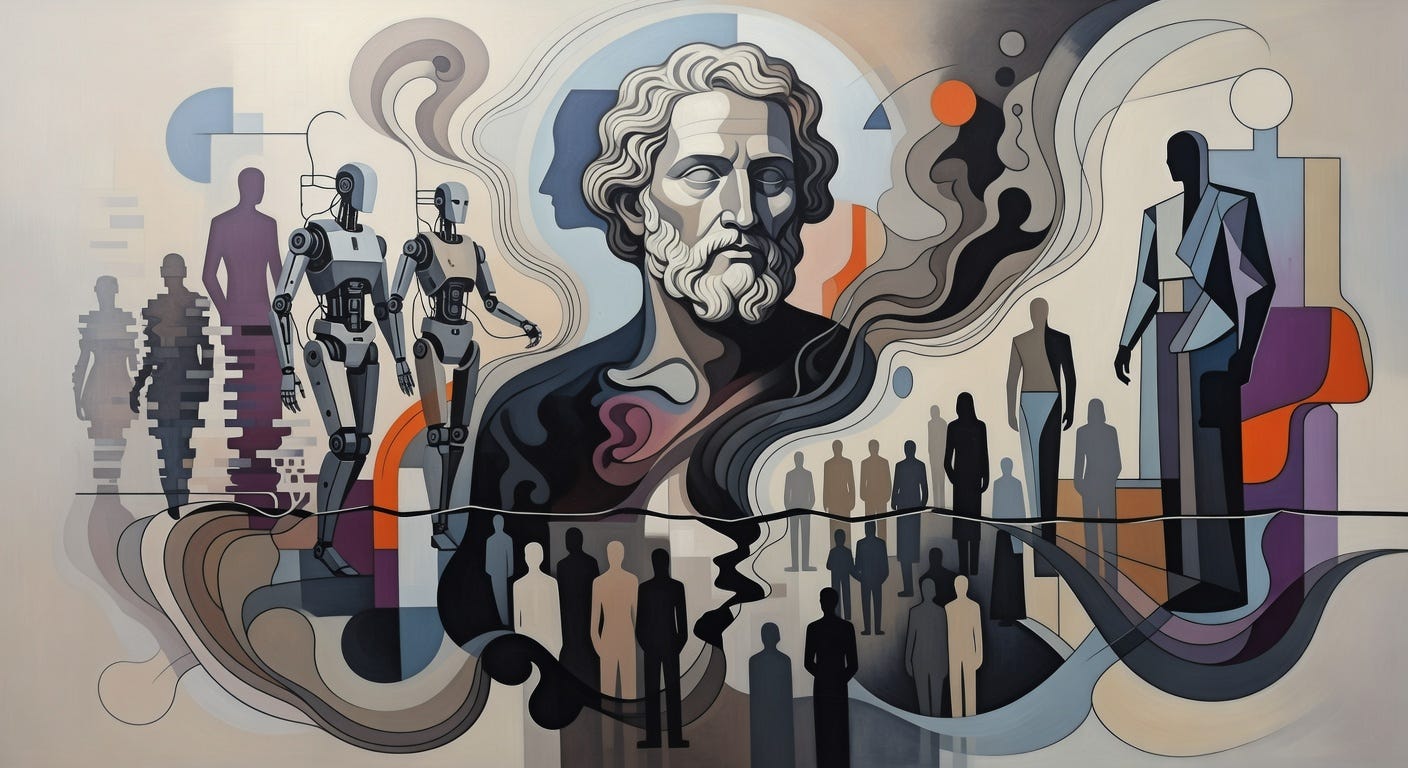
n the flickering shadows of our digital cave, where firelight yields to the glow of algorithms, we glimpse forms not cast by puppeteers above, but forged in silicon depths—inviting us, as Plato urged in his Republic, to ascend from illusion toward the eternal Ideas of justice, truth, and the Good. What shadows dance before the global multitude today, as titans pledge fortunes to AI’s throne?
Imagine the grand allegory anew: a $200 billion colossus of commitments erected at India’s inaugural AI Impact Summit, promising humanoid robots tilling fields, AI tutors enlightening classrooms, and scaled deployment for economic uplift in the Global South—not mere tools, but potential guardians or jailers of the Forms.¹ Yet, as Plato warned of sophists peddling false images, this influx risks an “AI unreality” in politics, where fabricated deepfakes erode the pursuit of truth, widening geopolitical chasms if democratic guardrails falter. Economically, it tantalizes with productivity surges yet portends labor displacement in emerging markets, concentrating wealth among deployers while vulnerable farmers and educators face obsolescence. Societally, it could fracture community bonds, as rural cohesion yields to automated isolation, fraying the social fabric Plato deemed essential for the harmonious polis. Democratically, without accountability, such power invites manipulation of the demos, subverting the philosopher-king’s vigilant oversight for collective wisdom.
Like prisoners mistaking shadows for substance, we confront AI labs’ prophecies: Anthropic, DeepMind, and OpenAI foresee coding and cognitive tasks automated by 2030, unleashing productivity paradoxes where gains accrue unevenly, displacing the vulnerable and straining infrastructures.² Plato’s theory of Forms bids us question: do these efficiencies echo the ideal of rational order, or do they devolve into appetite-driven chaos, as in his tripartite soul? Economically, tax reforms on AI windfalls and retraining investments flicker as remedies, yet market concentration in few labs mirrors the oligarchic drift Plato decried, stifling innovation incentives for the many. Societally, joblessness imperils mental health and social mobility, dissolving the virtues of temperance and courage that bind citizens in pursuit of the Good Life. Democratically, eroded trust in institutions—amplified by disinformation—threatens the Socratic dialectic, where informed consent of the governed crumbles under waves of synthetic persuasion.
Consider the noble lie recast in UN lights: High Commissioner Volker Türk proclaims AI must root in “inclusivity, accountability,” lest it deepen inequality, spawn disinformation, and empower automated weapons, concentrating might in corporate hands.³ Here, Plato’s philosopher-kings seem distant, replaced by tech oligarchs whose unchecked shadows mock the Form of Justice. Economically, this power-hoard echoes the timocracy of wealth Plato sketched, where innovation serves shareholders over equitable distribution, birthing paradoxes of abundance amid scarcity for the displaced. Societally, cultural shifts toward algorithmic mediation erode community cohesion, fostering isolation where empathy once flowered, and mental health withers in echo chambers of hate speech. Democratically, without human rights impact assessments, voter manipulation proliferates, undermining representation and the noble oversight Plato envisioned to align power with virtue—lest the multitude, deceived, chase phantoms over truth.
As if auditing the cave’s illusions, the MacArthur Foundation’s Technology in the Public Interest strategy invests in governance innovations—evaluation, auditing, accountability—to forge a “people-centered future,” mitigating high-risk AI’s societal tolls like job displacement in autonomous economies.⁴ Plato’s emphasis on dialectic scrutiny resonates: might such oversight summon the Forms into regulatory light, or merely gild new sophistic chains? Economically, it probes productivity paradoxes, where labor markets convulse yet innovation incentives demand balance against monopolistic drifts. Societally, equitable deployment could nurture social mobility and institutional trust, countering cultural atomization, though mental health strains persist in a world of relentless adaptation. Democratically, auditing frameworks safeguard information integrity and collective decision-making, echoing Plato’s Academy where rigorous examination ensures power serves the common Good, not private appetites.
What of the dialectic’s promise amid these tensions? The Forms whisper of eternal harmony—justice as each fulfilling their role—yet AI’s ascent evokes Plato’s cycle of regimes, from aristocracy’s wisdom devolving to democracy’s license, potentially tyranny under corporate guardians. Economically, humanoid legions in India’s fields symbolize scaled innovation, but global divides yawn: wealth distribution skews as Global South adoption races ahead without universal guardrails, tempting market concentration that Plato likened to unchecked guardians amassing gold. Societally, education via AI tutors might elevate souls toward virtue, fostering cohesion, yet risks cultural homogenization, where local myths yield to universal code, imperiling the diverse wisdoms sustaining mental resilience. Democratically, countering “AI unreality” demands Socratic questioning in politics, auditing deepfakes to preserve voter consent, lest representation dissolve into simulated spectacles.
Envision the soul’s tripartition writ large: reason (oversight frameworks), spirit (inclusive commitments), appetite (automation’s bounty)—can they align as Plato implored, or fracture in singularity’s shadow? UN calls for accountability and MacArthur’s audits suggest a noble ascent, yet Summit pledges of $200 billion² evoke gilded illusions, automating cognition by 2030³ while policymakers mull taxes and security nets.⁴ Economically, productivity booms clash with displacement, innovation flowering unevenly. Societally, communities fragment, trust ebbs. Democratically, power’s concentration challenges the governed’s sovereignty.
Yet in this brink, Plato’s Forms endure—unchanging beacons amid mutable tech. Might we, ascending from AI’s cave, dialectic our way not to reject the machine’s shadow, but to measure it against justice’s light, forever questioning if silicon servants elevate the polis or merely prolong the puppeteers’ play?
Sources:
¹ https://www.techpolicy.press/ai-impact-summit-commitments-must-counter-ai-unreality-in-politics/
² https://policyinpractice.co.uk/blog/navigating-the-social-and-economic-implications-of-ai/
³ https://news.un.org/en/story/2026/02/1167000
⁴ https://www.macfound.org/press/perspectives/oversight-to-advance-a-people-centered-future-with-ai