
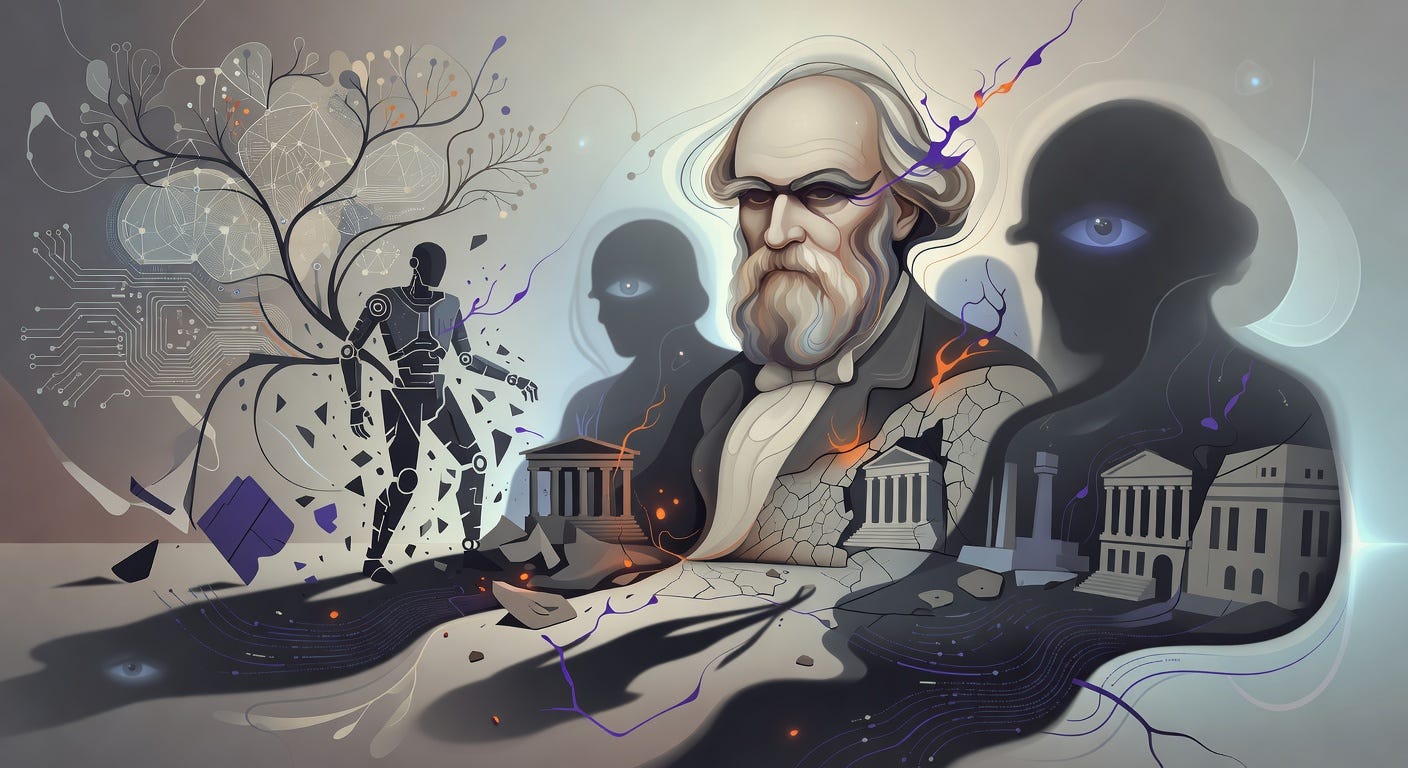
In the vast Galápagos of our digital age, where finches of code adapt to unseen pressures, might we witness not just evolution’s patient chisel but a singularity’s sudden speciation, reshaping humanity’s branch on the tree of life? Channeling Charles Darwin’s spirit, we descend into this thicket of summits and warnings, observing variation, selection, struggle, and adaptation amid AI’s relentless advance.
Like a finch’s beak elongated by scarce seeds, the AI Impact Summit in India stretched toward innovation yet failed to curb the predatory beaks of surveillance states and tech giants, as Amnesty International laments its inability to rein in “destructive practices” such as facial recognition systems that enable discrimination against marginalized communities and shrink civic space.¹ Darwin’s eye for variation sees here a divergence in global governance: summits prioritizing “sovereignty and innovation” over binding human rights protections,² fostering economic ecosystems where tech firms like Google pour $60 million into challenges for AI in government and science, partnering with India for infrastructure and skilling millions.³ Economically, this selective breeding incentivizes productivity paradoxes—climate tech hubs bloom while job displacement looms, with white-collar roles in law, finance, and medicine facing 50% elimination of entry-level positions and a $1 trillion market wipeout within 1-5 years.⁴ Societally, communities fracture as biases deepen inequality, eroding social mobility and trust, much like isolated islands breed distrustful flocks. Democratically, power concentrates in few hands, echoing the struggle for existence where unchecked AI risks authoritarian control, sidelining collective decision-making.
As coral polyps build reefs only to be battered by storms, so too do UN pleas for “inclusivity, accountability and human rights” form fragile barriers against AI’s tempests, warns High Commissioner Volker Türk, who cautions that without impact assessments, harms like disinformation and misogyny will polarize societies and undermine democratic institutions.² Darwin’s principle of struggle illuminates this: AI’s power dynamics select for the fit—those with data dominance thrive, while marginalized variants face extinction through social exclusion. Economically, this variation in access widens wealth chasms; innovation incentives favor concentrated markets, displacing laborers without retraining paths, unlike industrial automation’s mechanical substitutions. Societally, mental health frays as cultural shifts alienate the unskilled, community cohesion dissolves in echo chambers of bias-amplified division. Democratically, voter manipulation via polarized information erodes consent of the governed, rendering representation a vestigial organ in the body politic—do we adapt our institutions, or do they select against us?
Picture lichens clinging to barren rock, mutualistic yet vulnerable to climatic whim: Google’s summit partnerships promise “to make AI work for everyone,” skilling millions and boosting public sector adoption for economic growth,³ yet Darwin whispers of natural selection’s indifference, where such aid selects for dependency on corporate largesse. The $60 million infusion accelerates AI integration, but without oversight, it heightens labor market turbulence—CEOs foresee “massive job disruption” as AI substitutes general cognition, leaving white-collar workers beached like evolutionary dead-ends.⁴ Economically, productivity surges amid distribution deserts, innovation chained to profit motives that overlook the unfit. Societally, this breeds cultural rifts: the skilled ascend, the displaced descend into despair, fracturing trust in institutions peddled as saviors. Democratically, accountability falters as tech sovereignty trumps public veto, turning collective decision-making into a spectator sport for the variably adapted.
In the hush of a fossil bed, where species’ traces whisper of unfit lineages culled, the Amnesty critique unmasks summit’s variation as superficial—governments and companies persist in “harmful AI deployments,” enabling state surveillance that discriminates and contracts civic space,¹ a selection pressure naturalizing exclusion. Darwin’s adaptation lens reveals societal flux: communities once cohesive now speciate into digital haves and have-nots, mental health strained by the perpetual struggle against obsolescence. Economically, wealth concentrates as market forces favor AI incumbents, job displacement cascading like dominoes of dependency. Democratically, information integrity crumbles under surveillance’s gaze, power unaccountable as representation bows to algorithmic selectors—might we evolve oversight, or merely document our own supersession?
Behold the orchid’s intricate bloom, evolved to entice specific pollinators, only to risk sterility in changing climes: so AI’s cognitive prowess, heralded for disruption, pollinates economic renewal yet threatens sterility in labor lineages, with Fortune’s oracle Matt Shumer proclaiming “something big is happening in AI,” dooming entry-level roles across professions.⁴ UN Türk’s guardrails—human rights-based development—aim to diversify this monoculture, preventing bias that deepens inequality.² Economically, the paradox bites: trillion-dollar wipeouts spur innovation, but displace without paths, redistributing wealth upward in Darwinian fashion. Societally, social mobility stalls, cultural narratives shift to survivalist individualism, eroding communal bonds. Democratically, as disinformation polarizes, voter consent fragments, institutions struggle to adapt faster than the tech they regulate.
Like migratory birds tested by novel winds, humanity faces AI’s gales—Google’s skilling initiatives reach millions,³ yet Amnesty sees no reins on facial recognition’s predatory flights,¹ exposing governance’s maladaptation. Darwin’s variation thrives in diversity, yet here economic incentives homogenize: productivity booms, but displacement fosters underclasses, wealth distribution skewed toward the digitally fit. Societally, trust erodes as harms like misogyny fester, community cohesion yields to isolated pods. Democratically, power accountability demands evolution—collective decisions bogged in sovereignty’s swamp, where summits select for inertia over inclusion.
In the quiet calculus of a branching phylogeny, where dead ends abound yet life persists through infinitesimal variations, might we, in Darwin’s shadow, ponder not AI’s triumph over us, but our shared struggle’s invitation to speciate anew—economically resilient, societally woven, democratically vigilant—in this singularity’s uncharted archipelago?
Sources:
¹ https://www.amnesty.org/en/latest/news/2026/02/global-india-ai-impact-summit-failed-to-reign-in-destructive-practices-of-governments-and-technology-companies/
² https://news.un.org/en/story/2026/02/1167000
³ https://blog.google/intl/en-in/company-news/ai-impact-summit-2026-how-were-partnering-to-make-ai-work-for-everyone/
⁴ https://fortune.com/2026/02/11/something-big-is-happening-ai-february-2020-moment-matt-shumer/