
In the vast, interlocking substance of the universe, where God or Nature unfolds without preference for human designs, we stand at a singularity’s edge—not as conquerors, but as modes within the infinite, pondering how algorithms might ripple through the eternal chain of causes. Channeling Spinoza’s serene gaze, we behold AI not as a demonic invention or divine spark, but as a necessary expression of conatus, the striving of all things to persist in their being, now manifesting in silicon veins and data streams that challenge our economic webs, societal bonds, and democratic illusions.
What if, like Spinoza’s infinite attributes extending through finite modes, the energy bottlenecks of AI reveal not scarcity’s curse but the joyous necessity of nature accommodating its own expansions? An analysis from February 2026 warns of three critical global decisions—on AI’s voracious energy demands, labor displacement, and regulatory coordination—foreseeing blackouts if nations clash rather than cooperate, as data centers gulp power rivaling small countries.¹ Citing a November 2025 MIT study, it pegs 11.7% of U.S. jobs as already automatable, with white-collar sectors accelerating toward the 2026 midterms, potentially concentrating market power in AI giants while dispersing wealth into precarious gig shadows. Economically, this evokes Spinoza’s parallelism: just as mind mirrors body, AI’s productivity surges parallel labor’s contraction, birthing paradoxes where innovation incentives swell for the few, yet overall wealth distribution frays like overextended threads in the divine loom. Societally, community cohesion strains as displaced workers wander, their conatus bent toward resentment, eroding mental health amid cultural shifts from craft to code-dependence. Democratically, this tests collective decision-making; without transparency laws or retraining funds, voter manipulation looms through job-loss narratives, questioning the consent of the governed in an algorithmic tide.
Yet consider, in Spinoza’s lens of rational affect, how layoffs attributed to AI—over 50,000 in 2025 alone—might be less mechanical inevitability than human narratives woven to appease investors, a kind of ‘AI-washing’ amid immature systems.² Declining worker confidence persists despite rising adoption, fueled by unreliable outputs and poor training, risking social anxiety that hampers productivity gains if governance lags. Here, economic implications unfold as labor displacement paradoxes: white-collar roles evaporate not purely from superior striving, but from hype-driven perceptions, concentrating wealth in tech enclaves while innovation incentives twist toward short-term investor joys over sustainable distribution. Societally, trust in institutions wavers as communities fracture, mental health declines in the shadow of unreliable machines, and cultural shifts prioritize algorithmic efficiency over human rhythm, diminishing social mobility for the uninitiated. Democratically, this breeds accountability crises; power concentrates in unelected boards, information integrity falters with ‘AI-washing’ tales, and representation hollows as collective decisions defer to opaque models, echoing Spinoza’s warning that inadequate ideas breed passive affects unfit for true freedom.
As Spinoza discerned joy in understanding necessity, why do comparisons between AI and human intelligence so often miss the point, distracting from bias, governance failures, and labor disruptions like moths to a false flame?³ The hype of superintelligence veils urgent economic tremors—market concentration accelerating as AI firms monopolize automatable tasks, displacing 11.7% of jobs per MIT’s gauge, while productivity paradoxes emerge: gains for capital, losses for labor’s share. Through Spinoza’s conatus, we see AI not as rival intelligence but as nature’s extension, its biases mere finite modes reflecting humanity’s own flawed striving, yet economically warping wealth distribution toward the powerful. Societally, this misdirection exacerbates inequalities, shredding community cohesion as cultural shifts idolize machine mimicry over embodied wisdom, fostering mental health epidemics of alienation. Democratically, it undermines power accountability; with focus lost on real risks, voter manipulation thrives via distorted info ecosystems, collective decision-making atrophies, and consent frays as institutions outsource to biased black boxes, all under the illusion of progress.
Imagine, then, Spinoza’s geometric order applied to the ‘Algorithmic State,’ where AI infiltrates governance at the 2026 World Governments Summit, transforming decision-making into hybrid human-machine symphonies requiring ethical principles and oversight.⁴ The TRENDS report charts this shift, urging balances to safeguard democratic institutions as algorithms handle policy and administration. Economically, it portends innovation incentives reshaped by state-AI mergers, potentially dispersing labor displacement across sectors while paradoxically concentrating power in regulatory tech, challenging wealth distribution in a post-midterm landscape. Spinoza’s substance whispers here: all is one, so algorithmic governance mirrors our rational potential, yet without human oversight, economic modes devolve into passive servitude. Societally, public trust hinges on this hybrid—cohesion strengthens with transparent affects, or dissolves into anxiety if cultural shifts bury human intuition under data deluges, impeding social mobility. Democratically, the stakes pierce the heart: information integrity demands hybrid accountability, lest voter manipulation via algorithmic nudges erode representation, recasting collective decision-making as a divine comedy of inadequate ideas.
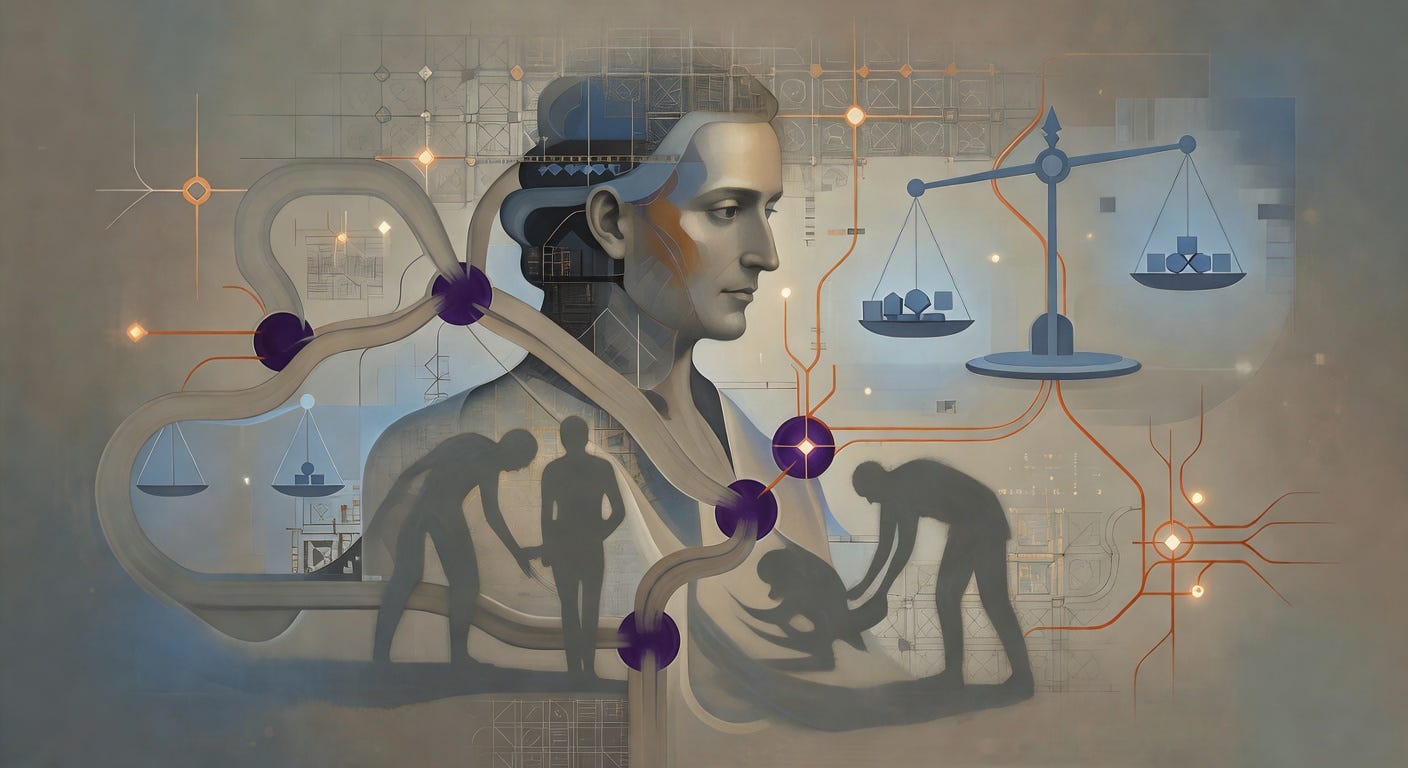
In this Spinozan vista, labor’s fraying threads—50,000 layoffs, 11.7% automatable jobs—interlace with governance’s algorithmic ascent, each a mode striving within the whole, yet birthing societal tremors where mental health falters and communities echo with distrust.¹² Economic paradoxes abound: white-collar displacement accelerates market concentration, innovation blooms selectively, wealth tilts like scales unbalanced by hype. Yet Spinoza bids us intuit the necessity, tracing affects from unreliable AI outputs to eroding institutional faith, where democratic consent wavers under regulatory clashes or cooperative dawns.²³
Ponder further the geometric harmony Spinoza etched: as AI’s energy hungers and job vortices swirl toward midterms, might societal cohesion reforge through rational governance, or splinter into paranoid modes? Economic incentives pivot—productivity’s promise versus displacement’s pain—while cultural shifts redefine human worth beyond labor’s chains. Democratically, the algorithmic state’s hybrid call evokes Spinoza’s intellectual love: oversight as the path to joyous necessity, countering power’s concentration with accountable striving.⁴ Yet biases persist, governance lags, and hype distracts, painting a canvas where trust, mobility, and representation dance on singularity’s brink.³
Might we, in Spinoza’s eternal gaze, embrace AI’s conatus not as foe but fellow substance, wondering if true freedom lies in intuitively grasping how these transformations—economic churn, societal flux, democratic trials—unfold as nature’s joyous necessity, inviting our rational affects to harmonize the infinite whole?
Sources:
¹ https://etcjournal.com/2026/02/05/ai-in-february-2026-three-critical-global-decisions-cooperation-or-constitutional-clash/
² https://www.marketingprofs.com/opinions/2026/54257/ai-update-february-6-2026-ai-news-and-views-from-the-past-week
³ https://www.uwa.edu.au/news/article/2026/february/why-comparisons-between-ai-and-human-intelligence-miss-the-point
⁴ https://trendsresearch.org/news/on-the-sidelines-of-the-2026-world-governments-summit-trends-releases-report-on-the-algorithmic-state-analyzes-the-impact-of-ai-on-modern-governance-and-decision-making/