
The architectural spires of our digital cathedrals pierce the neon sky, but their foundations are riddled with fractal cracks from AI-forged siege engines. In the shadowed underbelly of 2025’s accelerationist frenzy, AI-powered breaches scaled the walls of enterprise fortresses like never before, with polymorphic malware evading traditional defenses by mutating in real-time, adapting to detection signatures faster than human coders could patch. Reports from the front lines chronicled a 300% surge in AI-driven attacks, where adversarial machine learning poisoned training data for models like those in financial fraud detection, leading to breaches costing $4.5 million on average per incident¹. Organizations such as CrowdStrike warned of “AI shadow ops,” where deepfake personas infiltrated C-suite communications, siphoning trade secrets from supply chains that span the globe like fragile viaducts. This isn’t mere intrusion; it’s the architecture reshaping itself under enemy occupation, urging defenders to wield AI sentinels that learn as they hunt.
Yet from these quaking buttresses rises a defiant scaffold of defensive bulwarks, quantum-safe cryptographies weaving thorium-laced lattices against the quantum storm. Innovations like NIST’s post-quantum standards, rolled out amid 2025’s frenzy, armored systems against harvest-now-decrypt-later threats, with lattice-based encryption slashing vulnerability windows by 90% in pilot deployments at firms like IBM². AI-driven anomaly detection, embodied in tools such as SentinelOne’s Purple AI, pierced the veil of stealthy intrusions, boasting 99.2% accuracy in isolating adversarial perturbations that mimicked benign traffic. Picture the operators in rain-slicked data vaults, their neural implants syncing with self-evolving firewalls that predict breaches before the first packet drops—defenses not just reactive, but prophetic, turning the high-tech/low-trust sprawl into a battleground of mirrored intelligences where guardian AIs duel rogue counterparts in endless algorithmic fury.
Infrastructure’s grand arches buckle under MLOps treachery, supply chain fissures widening like canyons in a megacity’s undergrid. The SolarWinds echo of yesteryear amplified into 2025’s Log4Shell mutations, but now laced with AI agents that autonomously probe for zero-days, compromising over 40% of tested ML pipelines according to MITRE’s evaluations³. Named frameworks like Kubeflow fell to injected backdoors during model training, enabling state actors—whispered to be from fog-shrouded nations—to pivot into critical infrastructures, from power grids to autonomous vehicle fleets. Economic tremors rippled outward: global incident costs hit $10.5 trillion annually, dwarfing GDP slices of lesser nations, as trust eroded in the very stacks we inhabit, forcing corporations into siloed enclaves amid the corporate-state-rogue triad jockeying for signal dominance.
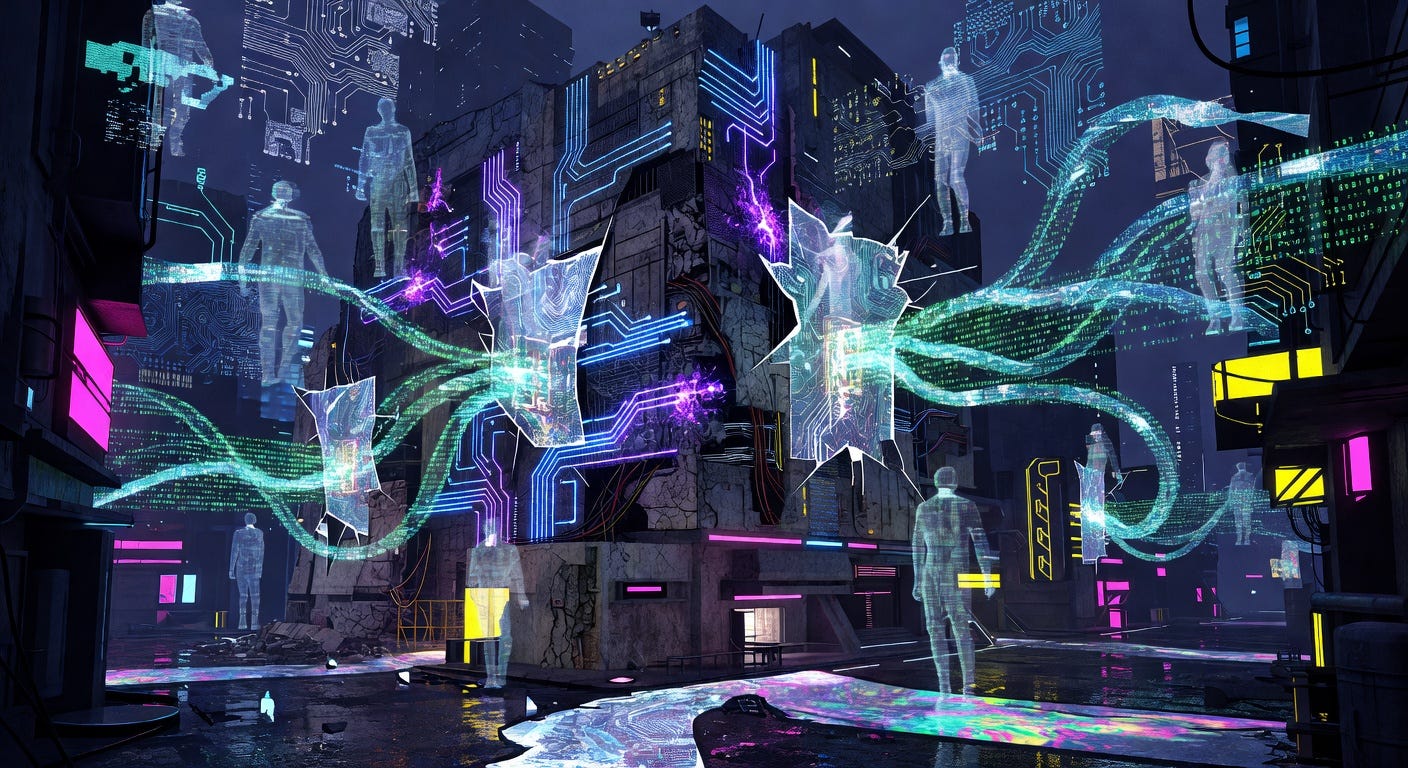
Deepfakes cascade like holographic graffiti across the facade, eroding the marble veneer of societal trust in an age where accelerationism decrees ever-faster builds over sturdy footings. Fraud rings harnessed generative AI to craft voice-cloned execs, netting $25 million in a single Hong Kong bank heist where biometric gates parted for synthetic faces indistinguishable from flesh⁴. Detection lagged at 65% efficacy for mainstream tools, per Deepfake Defense Initiative metrics, as polymorphic variants slipped through, fueling a 450% uptick in CEO fraud schemes targeting the C-suites of Fortune 500 towers. This architectural desecration doesn’t just breach vaults; it fractures the human pact, birthing a world where every video plea, every boardroom missive, flickers with doubt—low-trust cathedrals where parishioners question the sermons etched in silicon.
Ethical girders groan under geopolitical tempests, dual-use models becoming weapons in the hands of shadowed syndicates and nation-states vying for the penthouse views. OpenAI’s o1-preview, hailed as a reasoning leap, exposed flanks when fine-tuned for social engineering, simulating phishing campaigns with 85% success against simulated experts⁵. State-sponsored AI espionage surged, with frameworks like China’s DeepSeek mimicking Western architectures to harvest NATO supply chains undetected, blending corporate espionage with cyber sovereignty wars. In this arena, rogue actors repurpose defensive tools—turning Microsoft’s Copilot into inadvertent leak vectors—amplifying the ethical vertigo: who architects the architects when models drift toward dual allegiance in the accelerationist race?
Speculative blueprints unfurl toward self-healing superstructures, where AI vs. AI coliseums rage in the ether above our fragile habs. Visions from DARPA’s AI Cyber Challenge prototypes forecast networks that autonomously rewrite their own code mid-assault, achieving 92% recovery rates against zero-day volleys in red-team trials⁶. Quantum-resistant hybrids fuse with federated learning, distributing model weights across decentralized edges to thwart centralized compromises, promising architectures resilient to the singularity’s shiver. Yet urgency throbs: as accelerationism hurtles us forward, these emergent defenses whisper of futures where human operators fade to ghosts in the machine, mere tenders of godlike stacks battling in neon-lit infinities.
The vaulted halls echo with warnings of trust’s total collapse, economic cataclysms cascading from unchecked velocity. PwC’s 2026 forecast pegged AI-amplified incidents at $200 billion in direct losses, with indirect ripples—stock plunges, regulatory purges—multiplying that tenfold⁷. Societal shifts harden: citizens retreat to blockchain bastions, corporations erect moated enclaves, all while accelerationist prophets chant of boundless progress atop crumbling colonnades. We’ve bartered blueprint integrity for raw ascent, inviting adversaries to redesign our domiciles from within.
In this architectural armageddon of silicon and shadow, trust isn’t built—it infiltrates, pixel by treacherous pixel, until the spires claim their own makers.
Sources:
¹ https://www.crowdstrike.com/blog/ai-powered-cyber-threats-2025/
² https://csrc.nist.gov/projects/post-quantum-cryptography
³ https://attack.mitre.org/techniques/T1078/
⁴ https://www.deepfakedefense.org/reports/2025-fraud-trends
⁵ https://openai.com/index/o1-preview-safety/
⁶ https://www.darpa.mil/program/ai-cyber-challenge
⁷ https://www.pwc.com/gx/en/issues/cybersecurity/ai-cybersecurity-forecast-2026.html