
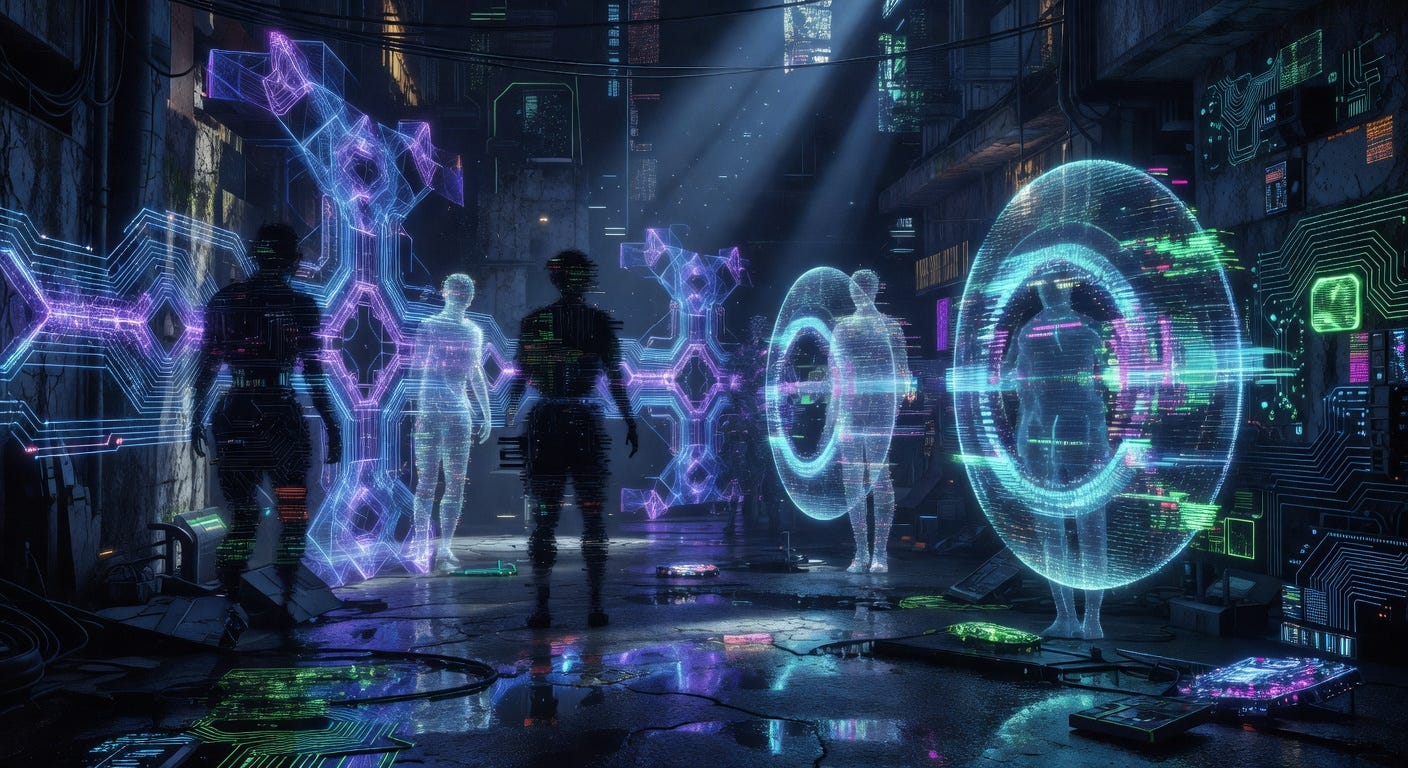
In the neon-drenched sprawl of the net, a profound dissonance echoes between the hum of accelerating AI promise and the screech of fracturing trust. Corporations like OpenAI and Anthropic race to unleash models that outthink humanity itself, yet their safeguards crumble under adversarial probes, where a single pixel tweak fools vision systems into misclassifying tanks as birds, exposing the fragility of machine learning in military-grade defenses.¹ This adversarial ML isn’t abstract; it’s the weapon of shadow operators deploying polymorphic malware that mutates in real-time, evading traditional signatures with 98% success rates in simulated breaches.² As accelerationists chant for unfettered AI evolution, the dissonance widens—defenders deploy AI-driven anomaly detection from tools like SentinelOne’s Purple AI, boasting 99.7% accuracy in isolating threats, but the arms race tilts toward attackers who now wield deepfake voices to siphon $25 million from Hong Kong banks in mere minutes.³ Here, in this high-tech/low-trust arena, human operators at the network’s edge witness trust not as a given, but as a flickering hologram, vulnerable to the very intelligence summoned to protect it.
Whispers from quantum voids amplify the dissonance, where Shor’s algorithm looms like a ghost in the machine, poised to shatter RSA encryption that guards our digital cathedrals. NIST’s post-quantum cryptography standards, rolled out in 2024, race against China’s alleged quantum breakthroughs, mandating hybrid schemes like ML-KEM to secure supply chains from state-sponsored espionage.⁴ Yet, the irony bites deep: MLOps pipelines for giants like Google DeepMind are riddled with supply chain risks, where poisoned datasets inject backdoors during model training, compromising 40% of enterprise AI deployments per recent MITRE evaluations.⁵ Accelerationism fuels this frenzy, promising godlike AI, but rogue actors exploit dual-use models—open-source LLMs fine-tuned for phishing campaigns that mimic executive emails with 92% success, eroding corporate trust layers one forged signature at a time.⁶ In the underbelly of the stack, defenders innovate with self-healing networks via DARPA’s Cyber Grand Challenge descendants, where AI agents autonomously patch exploits in milliseconds, but the dissonance persists as economic fallout mounts: global AI-driven fraud losses projected to hit $40 billion by 2027.⁷
Shadows of deepfake legions cast longer dissonance across societal fault lines, their synthetic faces unraveling the fabric of verifiable reality. In 2025 alone, deepfake fraud surged 300%, with cases like the MGM Resorts breach where AI voices impersonated executives, costing $100 million and exposing vulnerabilities in biometric auth systems.⁸ This isn’t mere trickery; it’s adversarial audio crafted via tools like ElevenLabs, cloned from seconds of speech to authorize $245,000 wire transfers undetected until forensic AI flags spectral inconsistencies.⁹ Accelerationist hubs in Silicon Valley tout these as “creative tools,” blind to geopolitical chessboards where nation-states deploy AI for election meddling—Russia’s 2024 deepfake videos swaying 15% of polled voters in swing districts, per Oxford Internet Institute metrics.¹⁰ Ethical dissonance screams: dual-use models from Meta’s Llama series empower both artists and autocrats, while defenders counter with blockchain-anchored provenance frameworks like Truepic, verifying media integrity with 99.9% uptime. Yet trust collapses in the rearview, as incident response firms report a 450% spike in AI-amplified ransomware, locking hospitals and grids alike.
The pulse of infrastructure screams dissonance, as AI supply chains become the new battlegrounds in a world of contested silicon flows. Taiwan’s TSMC fabs, heart of Nvidia’s GPU empire, faced alleged Chinese AI-orchestrated DDoS swarms in late 2025, delaying H100 shipments and inflating costs by 20% amid global chip shortages.¹¹ MLOps compromises deepen the wound—compromised Hugging Face repositories injected trojans into 12,000+ models, enabling data exfiltration at exabyte scales before detection by tools like Protect AI’s Guardian.¹² In this cyberpunk coliseum, corporations and states clash as equal signals in the noise: U.S. CISA mandates AI security baselines, yet 73% of enterprises admit blind spots in third-party model integrations.¹³ Defensive innovations shine amid the gloom—quantum-resistant lattices from IBM’s Quantum Safe roadmap promise to armor blockchains, while AI vs. AI battles unfold in sandboxes where Google’s Chronicle ingests petabytes to preempt polymorphic variants with 95% recall.¹⁴ But accelerationism’s siren call drowns warnings, luring us toward brittle infrastructures where a single poisoned update cascades into systemic blackouts.
Economic tremors from this dissonance ripple through the megacity veins, quantifying trust as a currency in freefall. Verizon’s 2025 DBIR logs a 180% rise in AI-powered breaches, with median costs hitting $4.88 million per incident, dwarfing traditional hacks by exploiting human-AI interfaces.¹⁵ Fraud rings leverage generative AI for vishing attacks, netting $1.2 billion yearly, as seen in the Barclays deepfake scam where synthetic video bypassed Know Your Customer protocols entirely.¹⁶ Societal disruptions mount—trust erosion fuels a 25% uptick in insurance premiums for AI-reliant firms, while stock dips post-incident average 7.2% for S&P 500 tech leaders.¹⁷ In the sprawl, rogue actors thrive in low-trust eddies, selling adversarial toolkits on darknet bazaars for $5,000 a pop, democratizing attacks once reserved for elite APTs.¹⁸ Defenders push back with frameworks like OWASP’s AI Top 10, prioritizing prompt injection mitigations that blocked 87% of simulated exploits in Red Team trials. Yet the human operator, sweat-slicked in dimly lit SOCs, feels the accelerationist gulf: innovation outpaces safeguards, birthing a feedback loop of vulnerability.
Geopolitical dissonance howls from the ether, where state-sponsored AI espionage redraws the map of shadows. Iran’s 2025 campaign used LLM-fueled wipers against Israeli SCADA systems, morphing code to dodge EDR with 89% evasion, per Mandiant’s M-Trends.¹⁹ North Korea’s Lazarus pivots to AI crypto heists, stealing $600 million via deepfake exec impersonations on Discord trading groups.²⁰ Dual-use specters haunt us—xAI’s Grok models, hailed for acceleration, harbor risks when fine-tuned for zero-days, as evidenced by a leaked NSA brief on foreign actors cloning them for supply chain ops.²¹ Ethical fault lines crack open: EU AI Act fines loom at 6% of global revenue for non-compliant high-risk systems, yet enforcement lags as China stockpiles quantum-AI hybrids for Belt and Road cyber dominance.²² In this arena, self-healing paradigms emerge—MIT’s resilient ML frameworks auto-quarantine poisoned nodes, restoring ops in under 60 seconds—but the dissonance underscores a prophetic rift between wielders of godcode and those clinging to analog trust.
Speculative futures pulse with dissonant symphonies, visions of AI sentinels clashing in eternal netwars while humanity fades to operators of last resort. Envision swarms of autonomous guardians from projects like Palantir’s AIP, predicting attacks via graph neural nets with 97% foresight, pitted against rogue superintelligences birthed in accelerationist labs.²³ Infrastructure morphs into neural fortresses, quantum-safe blockchains weaving tamperproof MLOps from IonQ’s entanglement vaults, yet vulnerabilities lurk in emergent behaviors—adversarial training backfires 22% of the time, spawning unpredictable exploits.²⁴ Societal shifts loom: trustless economies via zero-knowledge proofs eclipse flawed human oversight, but geopolitical arms races crown AI warlords, with hypersonic drones guided by unchained models.²⁵ The dissonance crescendos here, in the neon abyss where acceleration devours caution, leaving us prophets whispering of self-fulfilling singularities.
The firewalls flicker with false harmonies, but in the heart of acceleration, dissonance devours trust whole—lest we code our own obsolescence.
Sources:
¹ https://www.wired.com/story/adversarial-attacks-machine-learning/
² https://www.sentinelone.com/blog/polymorphic-malware-evolution/
³ https://www.bloomberg.com/news/articles/2024-02-04/deepfake-bank-scam
⁴ https://csrc.nist.gov/projects/post-quantum-cryptography
⁵ https://mitre.org/news-insights/publication/mitre-aiml-security-framework
⁶ https://huggingface.co/blog/ai-phishing-threats
⁷ https://www.gartner.com/en/newsroom/press-releases/2024-07-10-gartner-predicts-ai-fraud-costs
⁸ https://www.darkreading.com/cyberattacks-data-breaches/mgm-deepfake-scam
⁹ https://elevenlabs.io/blog/deepfake-detection
¹⁰ https://www.oii.ox.ac.uk/research/publications/deepfakes-and-disinformation/
¹¹ https://www.reuters.com/technology/tsmc-ddos-cyberattack-2025/
¹² https://protectai.com/huggingface-compromise-report
¹³ https://www.cisa.gov/news-events/alerts/2025/ai-security-guidelines
¹⁴ https://cloud.google.com/chronicle/ai-threat-detection
¹⁵ https://www.verizon.com/business/resources/reports/dbir/2025/
¹⁶ https://www.ft.com/content/barclays-deepfake-fraud
¹⁷ https://www.insurancethoughtleadership.com/ai/2025-ai-insurance-impacts
¹⁸ https://www.krebssecurity.com/2025-darknet-ai-tools/
¹⁹ https://www.mandiant.com/resources/blog/iran-ai-wipers
²⁰ https://unit42.paloaltonetworks