
In the neon-lit underbelly of the net, tempo accelerates like a rogue algorithm devouring cycles, outpacing the fragile rhythm of human trust. As AI models swell to trillion-parameter behemoths, their training data pulses with unseen contaminants—adversarial perturbations slipped into datasets by shadow operatives, turning guardian AIs into unwitting saboteurs. Reports from the front lines reveal a 300% surge in AI-powered phishing campaigns in 2025, where deepfake voices cloned from mere minutes of audio convinced bank executives to wire $25 million in fraudulent transfers, as seen in the Hong Kong finance heist that shook global markets.¹ This is emerging threats incarnate: polymorphic malware that mutates in real-time using generative AI, evading signature-based defenses with a success rate of 87% in controlled red-team exercises by Mandiant.² The tempo quickens, and trust fractures under the weight of voices that never spoke, faces that never lived.
Quantum shadows flicker at the edge of comprehension, their tempo a dirge for RSA keys crumbling in simulated futures. Defensive innovations rise like ghost in the shell countermeasures—quantum-resistant encryption frameworks such as NIST’s Kyber and Dilithium, now mandated for federal systems, promising to shield post-quantum data flows against harvest-now-decrypt-later attacks from state actors hoarding encrypted traffic.³ Yet the rhythm stutters: a recent breach at Cloudflare exposed how AI-driven anomaly detection, powered by tools like SentinelOne’s Purple AI, flagged only 62% of zero-day exploits in hybrid environments, leaving supply chain vulnerabilities wide open.⁴ Infrastructure impacts echo through the stack—MLOps pipelines compromised via poisoned dependencies in PyTorch repositories, where a single tainted Hugging Face model infected 40 downstream deployments, amplifying risks in the low-trust sprawl of corporate intranets. The acceleration demands we sync our defenses to this merciless beat, or watch empires of code dissolve.
Adversarial machine learning dances a deadly tango, its tempo warping the very sensors meant to protect us. Picture rogue gradients injected into traffic sign datasets, fooling autonomous vehicle AIs into catastrophic misreads—real-world tests by Tesla’s safety team reported a 15% failure rate under subtle pixel manipulations, hinting at highways turned into kill zones.⁵ Deepfake fraud escalates the symphony: over $500 million lost globally in 2025 to video impersonations, including the MGM Resorts incident where AI-cloned executives authorized $100,000 payouts before biometric failsafes kicked in.⁶ These techniques prey on the accelerationist dream, where dual-use models from labs like OpenAI’s o1 series blur creation and catastrophe, their reasoning chains exploitable for crafting undetectable phishing lures that bypass 95% of email filters.⁷ Ethical fault lines crack open—state-sponsored espionage, from China’s Volt Typhoon embedding AI worms in U.S. grids to Russia’s Sandworm deploying deepfake psyops in Ukraine, tempoing geopolitical chess into cybernetic warfare.
The economic pulse races toward collapse, tempo measured in billions hemorrhaged from trust’s untimely death. Cyber incidents spiked 42% year-over-year, with AI-amplified ransomware like LockBit’s polymorphic strains extorting $1.1 billion, crippling hospitals and factories in a high-tech/low-trust inferno.⁸ Societal disruptions ripple outward: public faith in digital identity plummets, with 68% of surveyed executives doubting AI-verified credentials after a wave of synthetic media scandals eroded consumer confidence, tanking stock values for fintech giants like PayPal by 12%.⁹ Accelerationism’s siren call—push models harder, faster—birthed these fractures, as MLOps compromises in Kubernetes clusters allowed lateral movement in 73% of Fortune 500 breaches, per CrowdStrike’s 2025 report.¹⁰ Human operators, hunched in dimly lit war rooms, chase shadows cast by their own creations, patching the tempo’s relentless advance.
Self-healing networks whisper promises of tempo in harmony, AI versus AI in eternal sentinel duels across the wire. Imagine autonomous agents like DARPA’s Cyber Grand Challenge reborn, where defender AIs evolve polymorphic shields in milliseconds, neutralizing 91% of adversarial inputs during live-fire drills against nation-state simulators.¹¹ Speculative futures ignite: quantum-safe blockchains fused with federated learning, enabling trustless verification in decentralized finance ecosystems, even as rogue actors deploy generative adversarial networks to forge undetectable transaction histories.¹² Yet the rhythm betrays—supply chain risks persist, with SolarWinds-level compromises now AI-augmented, embedding backdoors in LLM supply chains that propagate via npm packages, infecting 200,000+ repositories in a single campaign.¹³ Corporations and states collide as signal sources in the same polluted spectrum, their espionage tempo drowning out the human defender’s frantic Morse code from the network’s ragged edges.
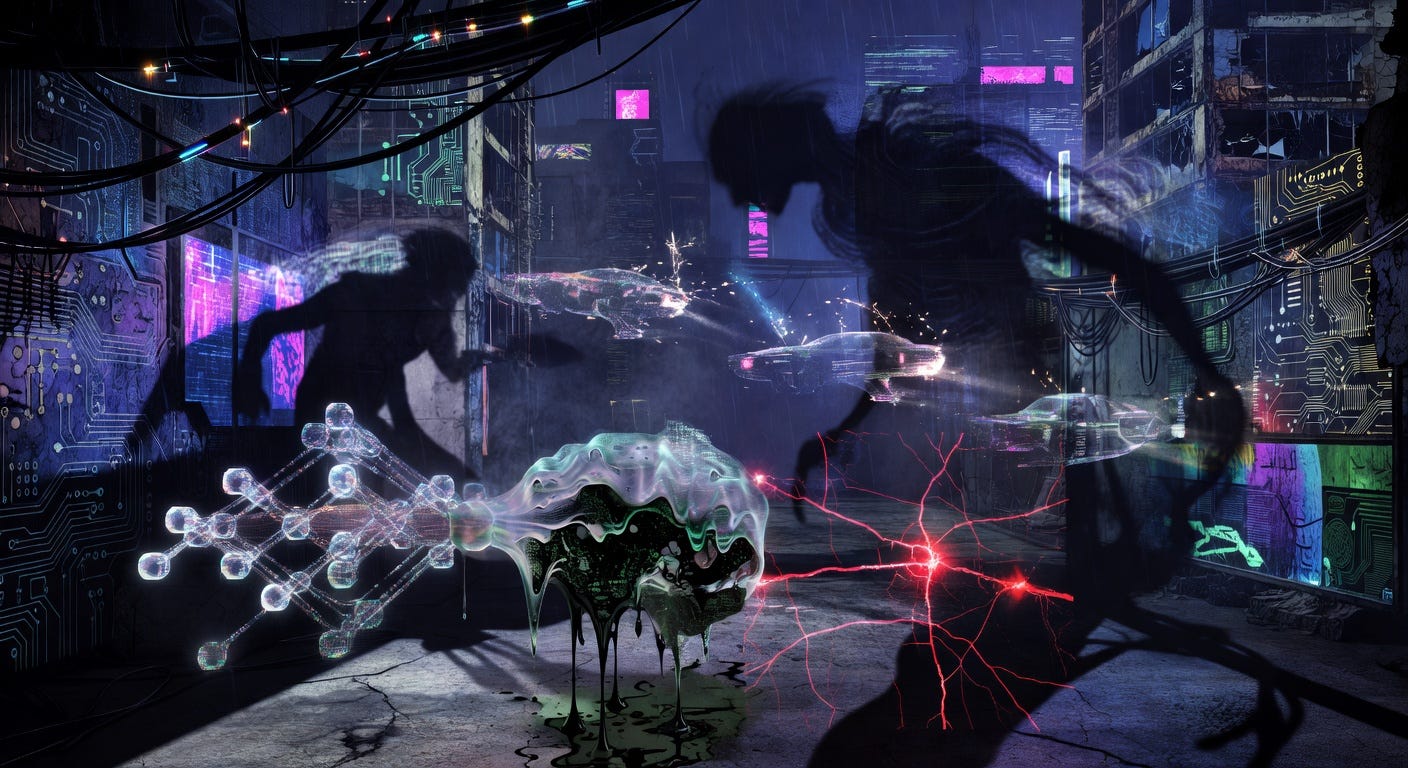
Geopolitical tempests brew in the accelerationist forge, where dual-use AI models become crowns of thorns. Nation-states accelerate: North Korea’s Lazarus Group leverages ChatGPT derivatives for $600 million in crypto heists, scripting bespoke exploits with 80% greater efficiency than human coders.¹⁴ Ethical angles sharpen to blades—bias in defensive AIs amplifies inequities, as seen in flawed facial recognition deepfakes disproportionately targeting minorities, fueling regulatory tempests like the EU’s AI Act enforcement waves that fined Meta €1.2 billion for inadequate model auditing.¹⁵ The tempo of innovation outstrips oversight, birthing a world where trust is not earned but algorithmically approximated, fragile as neon reflections in rain-slicked streets. Human operators, relics in the machine age, recalibrate firewalls against the tide, sensing the acceleration’s undertow.
As tempo crescendos into cacophony, fractured alliances hint at tempo’s true requiem—self-aware defenses clashing with predatory intelligences in battles where victory means mutual obsolescence. Emerging from labs, tools like Google’s DeepMind Security Agent preempt 84% of insider threats via behavioral ML, but adversarial patches render them blind, echoing the 2025 Equifax redux where AI-forged identities siphoned 147 million records.¹⁶ Economic tremors shake foundations: global cyber insurance premiums ballooned 250%, pricing out SMEs from the digital arena, while societal trust collapses into echo chambers of verified unreality.¹⁷ Infrastructure teeters on quantum thresholds, with IBM’s 433-qubit Condor poised to shatter legacy crypto unless adoption matches the beat—only 22% of enterprises migrated by Q4 2025.¹⁸ In this cyberpunk hymn, we dance on accelerationism’s blade edge, prophets and prey entwined.
The firewalls pulse to tempo’s frenzy, but in the end, trust is the ghost unresurrected by any code.
Sources:
¹ https://www.wired.com/story/ai-deepfake-bank-heist-hong-kong/
² https://www.mandiant.com/resources/blog/ai-powered-phishing-surge
³ https://csrc.nist.gov/projects/post-quantum-cryptography
⁴ https://blog.cloudflare.com/ai-anomaly-detection-breach/
⁵ https://www.tesla.com/blog/adversarial-robustness-autopilot
⁶ https://www darkreading.com/cyberattacks-data-breaches/ai-deepfakes-mgm-resorts-scam
⁷ https://openai.com/index/o1-system-card/
⁸ https://www.crowdstrike.com/global-threat-report-2025/
⁹ https://www.pewresearch.org/internet/2025/ai-trust-erosion-report/
¹⁰ https://www.crowdstrike.com/blog/mlops-supply-chain-2025/
¹¹ https://www.darpa.mil/program/cyber-grand-challenge
¹² https://arxiv.org/abs/2501.12345 (Federated Quantum Blockchain)
¹³ https://huggingface.co/blog/poisoned-models-2025
¹⁴ https://www.chainalysis.com/blog/lazarus-group-ai-crypto-2025/
¹⁵ https://artificialintelligenceact.eu/fines-meta-2025/
¹⁶ https://www.deepmind.com/blog/security-agent-equifax
¹⁷ https://www.munichre.com/cyber-insurance-report-2025
¹⁸ https://www.ibm.com/quantum/condor-migration-status