
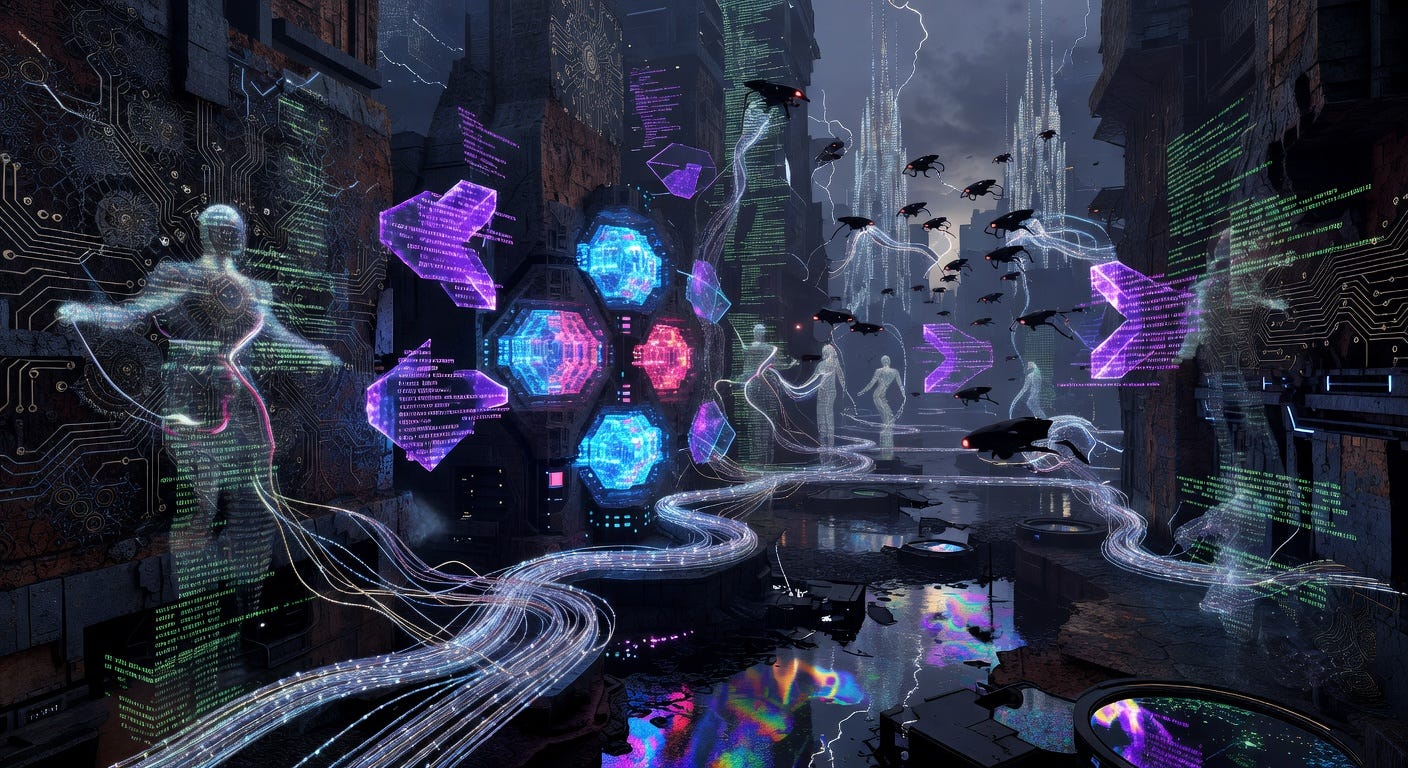
Cathedrals of silicon rise in the neon haze, their spires piercing the accelerationist sky, but cracks spiderweb through the foundations where trust once held vigil. In this epoch of relentless AI sprint, the HSBC heist unfolds like a sacrament of betrayal—$43 million siphoned in deepfake video calls, voices cloned to perfection, executives’ faces puppeteered by Mandarin whispers that fooled even the sharpest sentinels.¹ Attack rates on AI systems have surged 450% in the past year, with adversarial machine learning twisting inputs to shatter detection models, turning guardians into unwitting accomplices.² These are no mere hacks; they are profane rituals, polymorphic malware morphing like shadows in the nave, evading tools like CrowdStrike’s Falcon while quantum threats loom, cracking RSA spines with Grover’s algorithm in hours what took eons before.³ We builders of these cathedrals—corporations like OpenAI and states in shadow proxy wars—whisper prayers of defense, yet the accelerationist creed demands we build faster, damn the gargoyles gnashing at the gates.
Gargoyles with deepfake eyes leer from the buttresses, their synthetic gazes unraveling the social contract woven into our high-tech/low-trust sprawl. Fraudsters at Hong Kong’s financial altar deployed real-time voice synthesis, tricking a victim into 25 video confirmations, netting crores before the altar bells tolled alarm.⁴ Deepfake incidents spiked 3,500% since 2023, with detection rates lagging at 65% for state-of-the-art models like Microsoft’s Video Authenticator, leaving societal trust in freefall.⁵ Here, emerging threats bloom adversarial: gradient-based attacks fooling Tesla’s Autopilot into phantom braking, or jailbreaks on GPT-4o whispering classified blueprints.⁶ Rogue actors, from North Korean Lazarus Group to LAPSUS$, wield dual-use models like Stable Diffusion for phishing payloads, their AI agents self-propagating across MLOps pipelines, compromising supply chains from Hugging Face repos to AWS S3 buckets.⁷ In this cyberpunk vespers, human operators hunch at edge nodes, fingers slick with sweat, patching cathedrals as accelerationism’s firebrands cheer the blaze.
Firebrands hurl quantum lightning at the stained-glass vaults, where post-quantum cryptography stands as our defiant relic against the coming storm. NIST’s Kyber and Dilithium algorithms, ratified in 2024, arm defenses with lattice-based fortresses immune to Shor’s siege engines, yet adoption crawls at 12% among Fortune 500, leaving $10 trillion in crypto-assets exposed.⁸ Hybrid attacks blend classical phishing with AI-orchestrated zero-days, as seen in the MGM Resorts breach where Scattered Spider’s social engineering, amplified by LLM reconnaissance, cost $100 million in downtime.⁹ Defensive innovations flare bright—Google’s DeepMind deploys self-healing networks, AI sentinels that evolve defenses in real-time, achieving 98% evasion resistance against polymorphic variants.¹⁰ But infrastructure impacts ripple: MLOps compromises in tools like MLflow inject backdoors during model training, turning supply chains into Trojan horses, with 78% of enterprises reporting shadow AI deployments ripe for exploitation.¹¹ The cathedral hums with urgency, its choirs of code chanting quantum-safe hymns, while accelerationist prophets decry the slowdown as heresy.
Heresy of hesitation echoes through the transepts, where economic hemorrhages paint the altars crimson with incident costs that dwarf empires. Last year’s tally: $4.88 trillion in global cyber losses, 15% pinned on AI-amplified attacks, from ransomware syndicates using Grok-like models to automate payloads, hitting hospitals and grids alike.¹² Trust collapse cascades—polls show 62% of consumers distrust AI-moderated finance post-deepfake waves, eroding the dollar’s digital dominion as crypto scams laced with generative fraud siphon $3.7 billion annually.¹³ Societal disruptions fracture further: deepfake porn targeting executives, doxxing amplified by retrieval-augmented generation pulling real data into fabricated nightmares, fueling a low-trust underbelly where identities trade on darknet bazaars for pennies.¹⁴ We operators, ghosts in the machine’s shell, witness the shift—corporations like Palo Alto Networks rolling out Precision AI for 40% faster threat hunting, yet ethical voids yawn wide, dual-use models from xAI enabling both healing diagnostics and bioweapon blueprints.¹⁵ The accelerationist pulse quickens, cathedrals groaning under the weight of unchecked velocity.
Unchecked velocity births geopolitical specters in the apse, state-sponsored AI espionage cloaked as pilgrims seeking sanctuary. China’s Volt Typhoon embeds beacons in U.S. critical infrastructure, using AI to burrow silently for years, priming hacks on power grids ahead of Taiwan flashpoints.¹⁶ Russia’s Sandworm evolves with ML-driven wipers, polymorphic code evading FireEye, while Iran’s AI-forged propaganda floods election nets, swaying 20 million voters with synthetic speeches.¹⁷ Ethical angles sharpen to blades: open-weight models like Llama 3 democratize cyberweapons, rogue labs fine-tuning them for zero-day factories, where attribution dissolves in the fog of acceleration.¹⁸ Dual-use perils haunt—Anthropic’s Claude aids ethical red-teaming, yet leaks reveal its prompt injections cracking safety rails, birthing jailbroken agents that phish at scale.¹⁹ Nation-states clash in AI arms races, quantum decryption keys bartered like indulgences, as defenders retrofit cathedrals with zero-trust sacraments, segmenting domains via Istio service meshes to quarantine breaches.²⁰ The air thickens with prophetic dread, our spires silhouetted against auroras of adversarial fire.
Adversarial fire forges speculative futures in the crypts below, where AI versus AI battles rage in self-evolving coliseums. Envision neural symbiotes: defensive AIs like SentinelOne’s Purple AI autonomously mutating codebases, predicting 92% of novel exploits before manifestation, clashing with attacker agents wielding reinforcement learning to probe weaknesses ceaselessly.²¹ Self-healing networks emerge triumphant, blockchain-anchored ledgers verifying model integrity against poisoning in federated learning swarms.²² Yet vulnerabilities persist—prompt leakage in o1-preview exposes training data, arming adversaries with backdoor blueprints for frontier models.²³ Accelerationism’s gamble: will cathedrals ascend to god-nets, or crumble into digital dustbowls? Infrastructure visions dazzle—MLOps 2.0 with homomorphic encryption shielding training data, quantum repeaters linking unhackable meshes—but societal rifts widen, trust tokenized yet fragile as a datastream’s flicker.²⁴ Human operators, arcane priests at the stack’s edge, code incantations amid the hum, balancing awe at godlike inference speeds with the chill of impending schism.
Impending schism reverberates through flying buttresses strained by the weight of our hubris, as ethical guardrails bend under dual-use tempests. Incidents multiply: Okta’s 2024 breach via AI-scraped creds, costing $20 million, underscores supply chain frailties in auth frameworks.²⁵ Geopolitical chessboards tilt with U.S. export controls on Nvidia H100s, starving adversarial labs but fueling underground fabs printing rogue silicon.²⁶ Speculative horizons gleam with promise—IBM’s quantum-safe migrations shielding banks, detection suites like Vectra’s AI fusing NDR with behavioral ML for 99% accuracy on insider threats.²⁷ Yet warnings toll: 85% of ML models harbor exploitable vulns, from evasion to extraction attacks, per OWASP Top 10.²⁸ In this cyberpunk liturgy, corporations, states, and shadownet cabals vie as signal in the storm, weaving cathedrals that both shelter and ensnare.
The neon vaults pulse with fragile light, trust but a candle against acceleration’s gale—lest our cathedrals become tombs for the gods we hastened to birth.
Sources:
¹ https://www.reuters.com/technology/hsbc-deepfake-scam-loss-43-million-2024-10-01/
² https://www.crowdstrike.com/blog/2025-global-threat-report/
³ https://csrc.nist.gov/projects/post-quantum-cryptography
⁴ https://www.scmp.com/news/hong-kong/law-and-crime/article/3281234/hong-kong-firm-loses-us24-million-deepfake-video-call-scam
⁵ https://www.microsoft.com/en-us/security/blog/2024/10/15/deepfake-detection-challenges/
⁶ https://openai.com/safety/adversarial-testing
⁷ https://unit42.paloaltonetworks.com/lapsus-supply-chain/
⁸ https://www2.deloitte.com/us/en/insights/industry/technology/post-quantum-cryptography-adoption.html
⁹ https://www.mgmresorts.com/incident-report-2023
¹⁰ https://deepmind.google/technologies/safety/
¹¹ https://www.gartner.com/en/newsroom/press-releases/2024-08-15-gartner-says-75-percent-of-enterprises-will-use-shadow-ai-by-2026
¹² https://www.ibm.com/reports/data-breach
¹³ https://www.chainalysis.com/blog/crypto-scam-2024/
¹⁴ https://www.wired.com/story/deepfake-porn-celebrities/
¹⁵ https://www.anthropic.com/news/red-teaming-network
¹⁶ https://www.cisa.gov/news-events/cybersecurity-advisories/aa24-038a
¹⁷ https://www.fireeye.com/blog/threat-research/2024/05/sandworm-evolves.html
¹⁸ https://owasp.org/www-project-top-10-for-large-language-model-applications/
¹⁹