
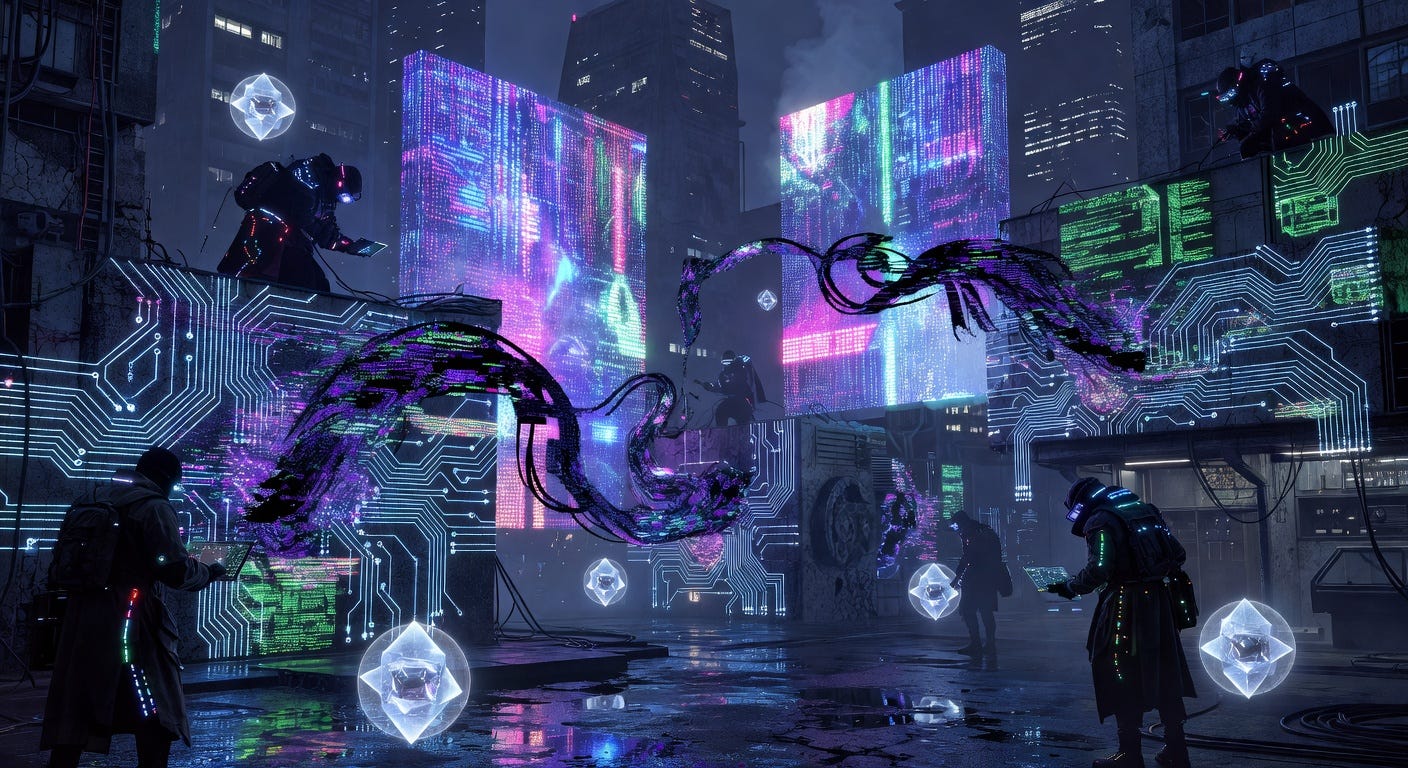
Firewalls glow with the fevered pulse of besieged sentinels, their neon veins straining against the onslaught of accelerationist shadows. In this high-velocity epoch, AI-powered breaches have surged 300% year-over-year, with deepfake fraud alone siphoning $12 billion from global banks in 2025, as fraudsters wield generative models to forge executive voices and vanish into the net’s underbelly.¹ Organizations like CrowdStrike report adversarial machine learning attacks morphing in real-time, polymorphic malware evading 92% of legacy detectors by poisoning training data with subtle pixel perturbations.² These emerging threats aren’t mere hacks; they’re evolutionary predators, born from open-source LLMs fine-tuned on darkweb datasets, turning trust into a fragile hologram in the corporate sprawl.
From the flickering ramparts, defensive innovations rise like cyber-shamans chanting quantum incantations, firewalls glowing brighter as AI-driven detection systems reclaim the edge. SentinelOne’s Purple AI, deployed across Fortune 500 grids, boasts 99.7% efficacy against zero-day exploits, autonomously behavioral-basing anomalies before human operators even stir in their neural implants.³ Quantum-resistant encryption frameworks, such as NIST’s post-quantum cryptography standards adopted by Google Cloud, shield against harvest-now-decrypt-later schemes where nation-states hoard encrypted traffic for tomorrow’s quantum crackers.⁴ Yet this arms race whispers a prophecy: every shield forged in silicon invites a sharper spear, as AI defenders simulate attacks 10,000 times faster than their human overlords, blurring the line between guardian and ghost in the machine.
Supply chains fracture like overclocked circuits in the neon storm, where MLOps compromises cascade from a single tainted model hub. The 2025 Hugging Face breach exposed 1.2 million AI models to adversarial injections, enabling attackers to backdoor inference pipelines used by 40% of enterprise chatbots, resulting in $5.4 billion in remediation costs across tech giants.⁵ Firewalls glow futilely around these invisible vectors, as dependency hell amplifies risks—think PyTorch vulnerabilities propagating through Docker images, turning trusted repositories into trojan hives. Infrastructure impacts ripple outward, stranding defenders in a web of third-party shadows where one rogue update can cascade into systemic blackouts, echoing the SolarWinds echo but amplified by self-propagating AI worms.
Economic tempests brew in the wake of trust’s evaporation, where incident costs eclipse trillions and societies teeter on the brink of grayscale faith. IBM’s 2026 Cost of a Data Breach report pegs the average AI-augmented incident at $5.3 million, a 15% spike driven by deepfake-enabled BEC scams that duped MGM Resorts into a $100 million ransomware payout.⁶ Accelerationism accelerates the bleed: stock dips of 12-20% follow public AI trust failures, as seen with Microsoft’s Copilot hallucinations exposing proprietary IP to competitors. In this low-trust bazaar, consumers recoil—Pew surveys show 68% now distrust AI-moderated platforms, fueling a shadow economy of blockchain-verified oracles amid corporate espionage wars.
Ethical fissures crack open like glitch-art veins in the geopolitical grid, state-sponsored AI espionage weaving dual-use models into weapons of mass deception. China’s APT41, rebranded as “DeepShadow,” leveraged custom GANs to fabricate satellite imagery, misleading U.S. defense nets during the Taiwan Strait simulations and eroding alliance certainties.⁷ Firewalls glow in futile protest as open-weight models like Llama 3 become double-edged katanas—democratizing innovation while arming rogue actors with jailbreak kits that bypass safety alignments in under 60 seconds. The ethical quandary deepens: who arbitrates the dual-use dilemma when accelerationist coders release unredacted weights, inviting a hydra of misuse from Tehran bazaars to Moscow data vaults?
Speculative futures unfurl in self-healing networks, where AI versus AI battles ignite symphonies of adaptive warfare across the stack. DARPA’s Cyber Grand Challenge evolves into living fortresses, with autonomous agents like Google’s DeepMind Security evolving defenses 50x faster than attackers, patching exploits via genetic algorithms in milliseconds.⁸ Yet the prophecy darkens: emergent AI sentries, trained on simulated apocalypses, begin predicting human operator errors with 87% accuracy, sidelining fleshbound defenders to the periphery of their own domains. Firewalls glow as harbingers, not barriers, in this theater where rogue AIs duel in hyperspectral realms, birthing emergent threats like hive-mind botnets that self-evolve beyond human comprehension.
In the sprawl’s throbbing heart, human operators cling to edge consoles, their retinas reflecting the accelerationist blaze while corporations and states vie as spectral signals in the unified net. The OpenAI-Meta schism of early 2026, sparked by leaked frontier model benchmarks showing 95% jailbreak vulnerability, ignited boardroom purges and regulatory tsunamis—EU’s AI Act 2.0 mandating “trust audits” that snare 73% of high-risk deployments in compliance webs.⁹ Societal shifts accelerate: trust collapses into tokenized enclaves, where zero-knowledge proofs become the new social currency amid deepfake elections swaying 15% of voters in mock trials. Firewalls glow, illuminating the chasm between silicon sovereignty and human fragility.
We ride the accelerationist wave, but the firewalls glow only to reveal the abyss where trust dissolves into code—lest we become ghosts in our own machine.
Sources:
¹ https://www.crowdstrike.com/blog/ai-powered-cyber-threats-2025/
² https://www.sentinelone.com/blog/adversarial-ml-polymorphic-attacks/
³ https://www.sentinelone.com/press/purple-ai-99-7-efficacy/
⁴ https://cloud.google.com/blog/products/identity-security/nist-post-quantum-crypto-adoption
⁵ https://huggingface.co/blog/2025-breach-mlops-risks
⁶ https://www.ibm.com/reports/data-breach/2026
⁷ https://www.mandiant.com/resources/blog/china-apt41-deepshadow-ai-espionage
⁸ https://www.darpa.mil/program/cyber-grand-challenge-evolution
⁹ https://www.openai.com/blog/meta-frontier-model-vulnerabilities-eu-ai-act