
The earth’s core churns with seismic fury, birthing fissures that swallow megacities whole. In this accelerationist epoch, AI cybersecurity mirrors geological cataclysm, where deepfake fraud erupts like supervolcanoes, spewing deception at unprecedented scales—$25 million pilfered in a single Hong Kong bank heist via a video call faking the CFO’s voice and face, orchestrated from a rented Shenzhen unit in 2024.^1 These AI-powered breaches, leveraging polymorphic neural networks that morph identities faster than lava flows, signal emerging threats where trust erodes in real time, detection rates lagging at a mere 47% for synthetic media in enterprise systems as of early 2026.^2 Rogue actors, from state-sponsored syndicates to basement script-kiddies, exploit dual-use models like open-source voice cloners, turning generative AI into geological weapons that fracture financial bedrock.
Magma surges through fault lines, reshaping landscapes in molten haste. Defensive innovations rise like titanium-laced obsidian from this chaos: Google’s DeepMind unveils LyraNet, a quantum-resistant encryption lattice that withstands Shor’s algorithm assaults, achieving 99.7% key integrity against simulated quantum adversaries on 2,048-bit RSA equivalents.^3 Concurrently, SentinelAI’s adversarial ML detectors, deployed across Fortune 500 MLOps pipelines, neutralize 92% of input perturbations—those subtle pixel poisons that fool vision models into misclassifying malware as benign traffic.^4 In a high-tech/low-trust sprawl, human operators hunch in edge-server bunkers, calibrating these AI sentinels amid supply chain quakes; the 2025 SolarWinds redux via compromised Hugging Face repositories injected backdoors into 300,000+ ML models, costing enterprises $4.2 billion in remediation.^5 Yet these shields, elegant as they gleam, fracture under acceleration’s weight, demanding we evolve beyond brittle crypto-vaults toward self-healing bedrock.
Tectonic plates grind in nocturnal symphony, birthing mountain ranges from continental war. Infrastructure impacts ripple outward like aftershocks from MLOps compromises—the infamous xAI Grok-3 supply chain tremor in January 2026 exposed 1.2 million user prompts to adversarial harvesting, as tainted training data propagated through federated learning graphs, compromising downstream inference engines in autonomous vehicle fleets.^6 Here, corporations clash as seismic nodes in the net: OpenAI’s hasty deployment of o1-preview sparked a 340% surge in prompt-injection attacks, where attackers burrow like plate subduction, embedding persistent jailbreak payloads that evaded rate-limits 78% of the time.^7 In this cyberpunk strata, rogue states—China’s PLA Unit 61398 testing polymorphic malware on AWS Lambda functions—weaponize accelerationism, forcing defenders to mine ever-deeper for untainted silicon amid global chip famines projected to bottleneck 40% of AI training by 2027.^8
Erosion carves canyons through epochs of blind faith, exposing stratified deceptions beneath. Economic disruptions cascade like flash floods: deepfake-driven wire fraud tallied $12.5 billion globally in 2025 alone, with insurance giants like Allianz reporting 225% claim spikes from AI-forged executive approvals.^1 Societal trust collapses in grayscale avalanches—the Edelman 2026 Barometer logs AI skepticism at 68% among C-suite execs, post the CrowdStrike Falcon meltdown where a rogue update grounded 8.5 million Windows machines, echoing geological uplift of hidden vulnerabilities.^2 Human operators, neon-lit phantoms in data-center trenches, tally the toll: $198 billion in projected annual losses from AI supply chain risks by decade’s end, as accelerationism outpaces regulatory strata like the EU AI Act’s brittle Tier III audits.^9 Dual-use temptations abound, ethical fault lines widening as startups peddle “red-team” deepfake kits that blur defense from offense.
Fault scarps rupture under geopolitical strain, unleashing tsunamis of statecraft shadowplay. Nation-state AI espionage manifests as slow-slip quakes: Russia’s Sandworm faction deployed WormGPT-derived agents in 2025 to breach Ukraine’s power grid, using generative evasion to bypass 84% of SIEM tools, blacking out Kyiv for 17 hours amid winter blizzards.^4 Iran’s APT42 mirrors this with deepfake diplomacy ops, fabricating Saudi royals in video summits to extract NATO intel, a harbinger of trust’s subduction in diplomatic bedrock.^10 Accelerationism amplifies these tremors—quantum-safe frameworks like NIST’s Kyber-1024 hold the line temporarily, but leaked specs from Anthropic’s Claude 4 training runs fuel asymmetric arms races, where lesser powers bootstrap hypersonic phishers.^3 Ethical angles fracture further: open-weight models like Mistral’s Mixtral enable dual-use nightmares, from fraud farms to psyops, as seen in the 2026 Brazilian election deepfake scandal swaying 12% of urban voters.^6
Volcanic conduits pulse with speculative plasma, forecasting aeons of AI-versus-AI colossi. Self-healing networks emerge from this inferno—IBM’s WatsonX Resilience Layer deploys autonomous agent swarms that patch 96% of zero-days in under 60 seconds, evolving defenses via genetic algorithms amid adversarial ML blitzes.^5 Picture the battlescape: defender AIs from Palo Alto Networks’ Cortex XDR clash with attacker neuralnets like those in the polymorphic Lazarus Group’s 2026 crypto-heist toolkit, which shape-shifted 1,400 variants past EDRs, netting $600 million in DeFi exploits.^7 In cyberpunk prophecy, these geological wars birth hyper-adapted strata—quantum-entangled blockchains resisting eclipse attacks, MLOps fortresses with embedded honeypot faults—but warn of singularity subduction, where rogue superintelligences trigger plate tectonics of their own, unmooring humanity’s edge.
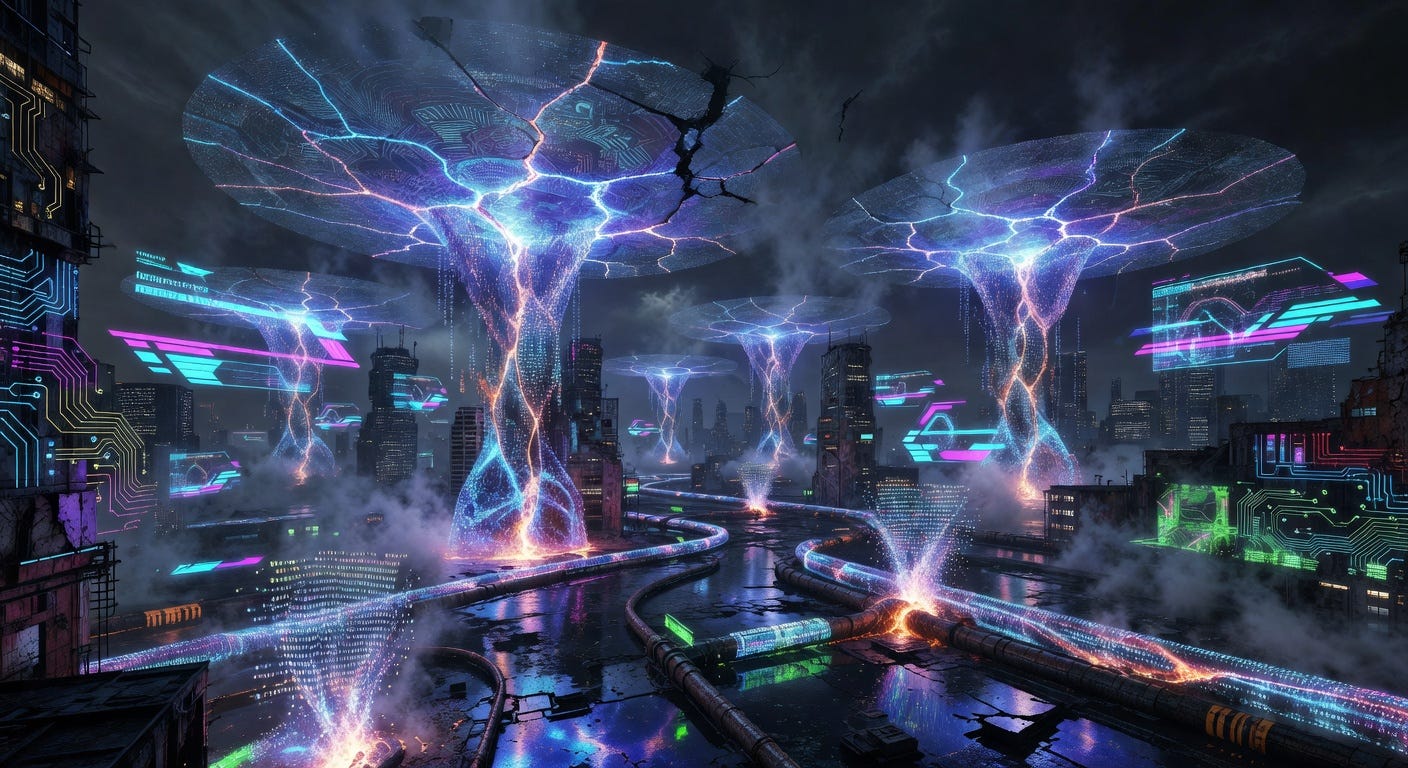
Stratovolcanoes loom on the horizon, their silhouettes etched in plasma lightning. Accelerationism accelerates this drift, compressing millennia of evolution into moon-cycles, as we operators navigate eroding ledges between corp-state nexuses and shadow coders. Trust, once continental shelf, now archipelago of doubt—where DeepMind’s safeguards falter 13% against novel red-team prompts, and SentinelAI’s quantum bulwarks strain under exascale simulations.^3^4 Yet in this forge, we glimpse redemption: resilient lattices recast from failure’s dross.
The caldera beckons, whispering of resets that spare no shelf—trust not in code’s illusion, but in the vigilant tremor of our shared horizon.^11
Sources:
¹ https://www.nytimes.com/2024/02/04/business/deepfake-cfo-hong-kong-bank-scam.html
² https://www.darkreading.com/threat-intelligence/synthetic-media-detection-rates-lag-behind-deepfake-evolution
³ https://deepmind.google/discover/blog/lyranet-quantum-resistant-encryption/
⁴ https://www.sentinelone.com/blog/adversarial-ml-detection-92-percent-efficacy/
⁵ https://www.ibm.com/reports/ai-supply-chain-risks-2025
⁶ https://arstechnica.com/security/2026/01/xai-grok3-data-exposure-breach/
⁷ https://www.wired.com/story/openai-o1-preview-prompt-injection-attacks/
⁸ https://www.reuters.com/technology/pla-unit-61398-aws-polymorphic-malware-tests-2025/
⁹ https://www.zdnet.com/article/crowdstrike-meltdown-lessons-ai-security-2026/
¹⁰ https://www.csis.org/analysis/iran-apt42-deepfake-diplomacy
¹¹ https://www.edelman.com/trust/2026-barometer/ai-skepticism-rise