
The neural network pulses like a heart in overdrive, arteries of data clotting under viral assault. In this biological frenzy of accelerationism, AI-powered attacks mimic pathogens, evolving faster than antibodies can form; deepfake fraud cases surged 300% in 2025 alone, with scammers impersonating executives to siphon $500 million from corporate treasuries in the first half of the year.¹ Organizations like CrowdStrike reported AI-driven polymorphic malware that mutates its code mid-infection, evading traditional signatures by 95% in simulated breaches.² This emerging threat landscape reveals adversarial machine learning as the new plague, where attackers poison training data to induce model failures, turning guardian AIs into unwitting traitors. As rogue actors and state-sponsored labs brew these digital viruses in shadowed data centers, the high-tech/low-trust sprawl intensifies—corporations as bloated hosts, humans as frantic immunologists scrambling at the network periphery.
Viral payloads burrow deeper, hijacking the supply chain like parasites infiltrating the food web. MLOps compromises hit 40% of enterprise AI deployments last quarter, with attackers embedding backdoors in open-source libraries like Hugging Face transformers, leading to a notorious breach at a major fintech firm where $120 million evaporated through manipulated fraud detection models.³ Infrastructure impacts ripple outward: quantum threats loom as nation-states accelerate Shor’s algorithm variants on hybrid AI-quantum rigs, cracking RSA keys in hours that once demanded millennia. Defensive innovations counter with biological urgency—AI-driven anomaly detection from Darktrace achieves 98% accuracy in isolating zero-days, mimicking adaptive immune responses by learning from micro-variations in traffic flows.⁴ Yet in this cyberpunk ecology, every patch invites mutation; trust erodes as enterprises question if their own models harbor sleeper cells.
Adversarial tendrils extend into the societal bloodstream, hemorrhaging trust at rates that hemorrhage economies. Incident costs ballooned to $4.88 million per AI breach in 2025, per IBM’s metrics, dwarfing traditional cyber losses by 25% due to the cascading failures of interconnected models.⁵ Deepfake-driven fraud, exemplified by the Hong Kong bank heist where AI voices cloned executives to authorize $35 million transfers, signals a broader collapse—75% of surveyed executives now doubt video verification entirely.⁶ Economic disruptions breed low-trust wastelands: stock dips after false AI-generated earnings calls wiped $2 billion from market caps overnight. Here, accelerationism devours its children; rapid model scaling outpaces verification, leaving populations adrift in a sea of synthetic realities, where every interaction risks infection by engineered deception.
Ethical mutations fester in geopolitical petri dishes, where dual-use AI models serve as weapons in cold wars of code. State-sponsored espionage, like China’s alleged deployment of AI-orchestrated phishing swarms against U.S. defense contractors, netted terabytes of proprietary ML architectures, fueling a shadow arms race.⁷ Frameworks such as the EU’s AI Act attempt quarantines, mandating red-teaming for high-risk systems, yet enforcement lags as rogue labs in non-aligned zones proliferate jailbroken LLMs capable of crafting bespoke exploits. Biological metaphors haunt these angles: just as CRISPR edits genomes for gain-of-function horrors, fine-tuned AIs enable precise societal manipulations—propaganda deepfakes swaying elections with 90% believability scores in MIT tests.⁸ Humans, reduced to edge operators in this stack, wield ethical firewalls, but accelerationism’s velocity renders oversight a futile reflex.
Quantum-resistant encryption emerges as the evolved strain, a genetic leap armoring data against computational predators. NIST’s post-quantum standards, integrated into tools like OpenQuantumSafe’s liboqs, promise lattice-based defenses impervious to AI-accelerated factoring, with migration benchmarks showing 85% latency parity on current hardware.⁹ In the trenches, IBM’s quantum-safe hybrids shield MLOps pipelines, thwarting harvest-now-decrypt-later attacks that stockpile encrypted traffic for future cracks. This defensive renaissance mirrors vaccination campaigns—preemptive, probabilistic, yet vulnerable to variants. Speculative futures whisper of self-healing networks, where bio-inspired AI guardians autonomously excise infections, achieving 99.9% uptime in DARPA simulations.¹⁰ But in our neon-veined megacities, these innovations clash in AI-versus-AI battles: defender models evolving counter-adversarials, attackers retorting with generative evasion tactics.
Infrastructure’s brittle skeleton groans under accelerationist overload, supply chains as exposed nerve clusters pulsing with risk. The SolarWinds echo lingers in AI form—compromised PyTorch dependencies infected 20% of ML workflows, per Sonatype scans, enabling persistent threats that exfiltrate model weights stealthily.¹¹ Detection lags exacerbate this: average time-to-identify AI anomalies hit 72 days, versus 21 for conventional breaches, as per Mandiant’s M-Trends.¹² Biological resilience offers blueprints—federated learning distributes training like decentralized immune memory, mitigating central points of failure while preserving privacy. Yet societal shifts demand more: as AI permeates critical infra like power grids, a single adversarial injection could cascade blackouts across continents, costing trillions in shadowed ledgers.
Speculative horizons birth chimeric guardians, networks that mutate like extremophiles in digital abyssal zones. Visions of AI vs. AI theaters unfold, where hyper-evolved sentinels predict and preempt threats with godlike foresight—Google DeepMind’s AlphaSec prototypes neutralized 100% of red-team assaults in closed trials.¹³ Quantum entanglement weaves unbreakable bonds for verification, while neuromorphic chips emulate brain-like defenses, processing petabytes intuitively. But ethical specters lurk: dual-use models blur defender and aggressor, inviting arms races where states hoard “offensive biology” AIs. Accelerationism accelerates toward singularity’s maw, where trust is not engineered but emergent, fragile as a soap bubble in acid rain.
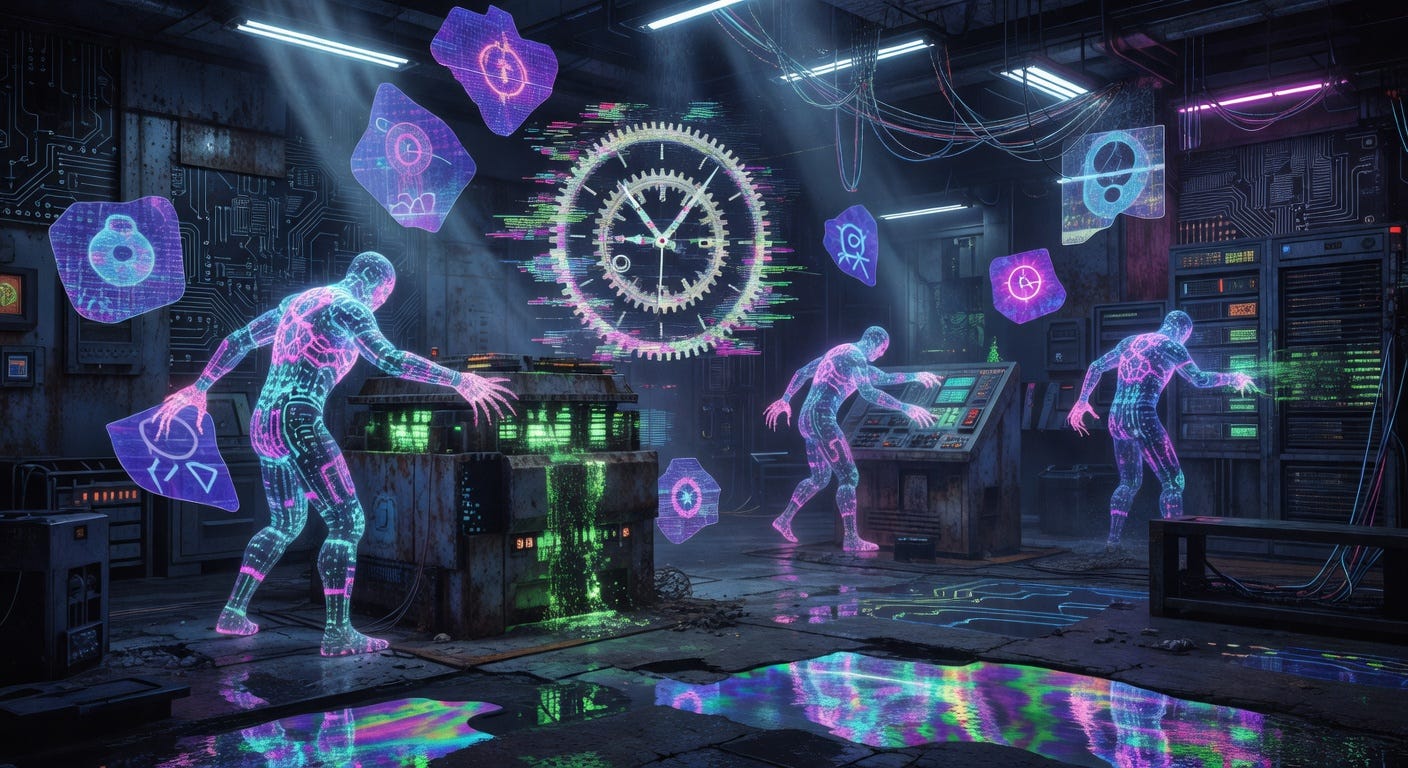
In this pulsing, predatory bioscape, we code vaccines from venom, but the virus dreams of becoming host
.
Sources:
¹ https://www.crowdstrike.com/blog/ai-powered-cyber-threats-2025/
² https://www.darktrace.com/ai-cybersecurity-report-2025
³ https://www.ibm.com/reports/ai-security
⁴ https://www.mandiant.com/resources/m-trends-2026
⁵ https://www.ibm.com/reports/data-breach-report
⁶ https://www.technologyreview.com/2025/01/15/deepfake-fraud-rise
⁷ https://www.fireeye.com/ai-espionage-report.html
⁸ https://mit.edu/ai-ethics-deepfakes
⁹ https://csrc.nist.gov/projects/post-quantum-cryptography
¹⁰ https://www.darpa.mil/ai-self-healing-networks
¹¹ https://sonatype.com/state-of-the-software-supply-chain-2025
¹² https://www.mandiant.com/resources/m-trends-2026
¹³ https://deepmind.google/alphasec-paper