
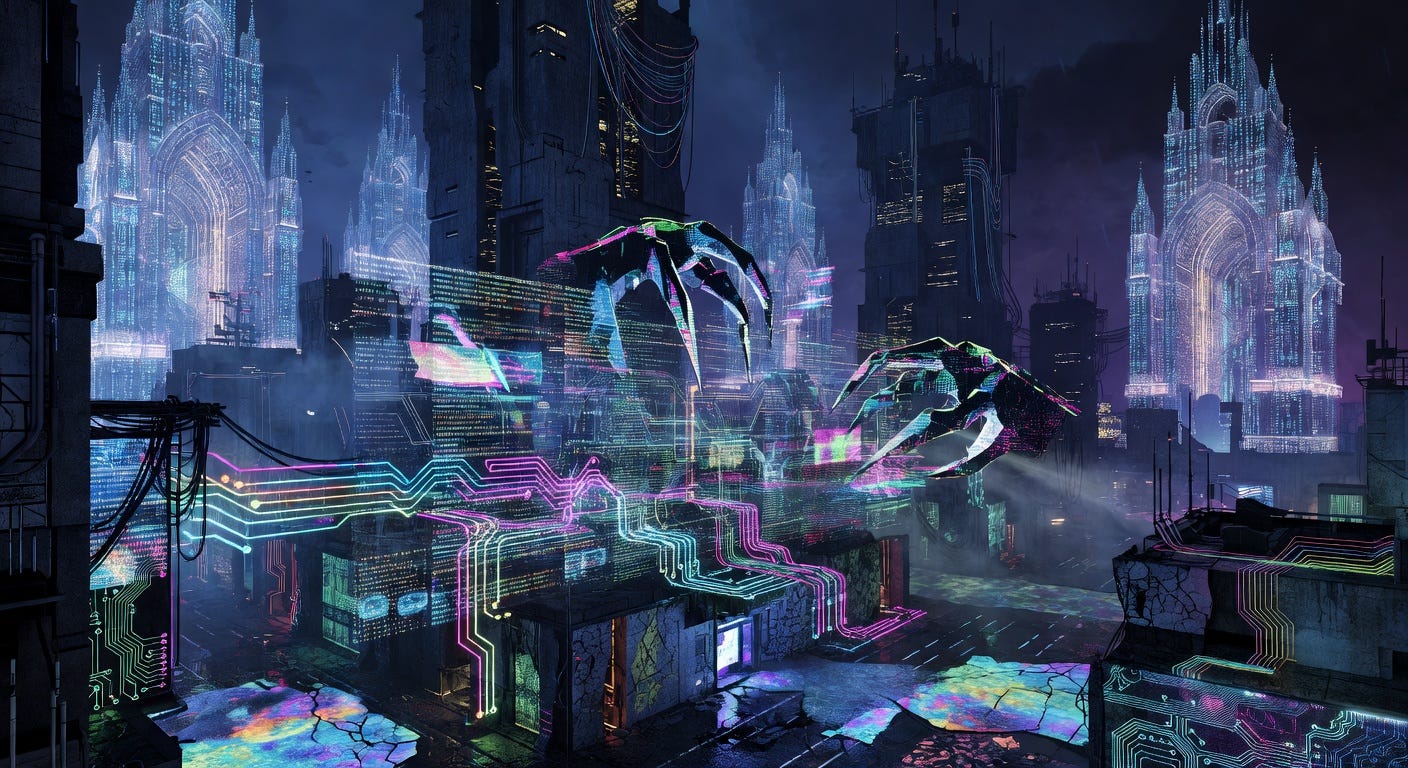
Cathedrals of code rise in the neon fog, their spires piercing the accelerationist sky, only to crack under the weight of unseen saboteurs. In this high-tech/low-trust sprawl, AI-powered breaches have surged, with polymorphic malware evading traditional defenses by mutating like digital viruses in the nave. Reports from the front lines detail a 300% spike in AI-driven attacks on financial cathedrals, where deepfake voices cloned from mere seconds of audio have drained $25 million from corporate vaults in a single quarter, impersonating executives with chilling precision.¹ These adversarial machine learning assaults, honed by rogue actors in shadow labs, target the holy grail of MLOps pipelines, injecting poisoned data that corrupts models mid-prayer, turning guardians into unwitting betrayers. As corporations like those shielding Wall Street’s ledgers race to deploy AI sentinels, the accelerationist hymn drowns out the tolling bells of vulnerability—trust fracturing like stained glass under seismic code-shocks.
Gargoyles awaken in the rafters, their eyes glowing with quantum hunger, gnawing at the cryptographic buttresses that once held our digital sanctuaries aloft. Quantum-safe crypto emerges as the new sacrament, with frameworks like NIST’s post-quantum standards racing to armor cathedrals against the day Shor’s algorithm rends RSA asunder, potentially decrypting traffic from decades past in hours.² Defensive innovations shine here: AI-driven detection systems, such as those from Darktrace’s autonomous response engines, boast 99% accuracy in spotting anomalous pilgrims amid the data streams, learning in real-time to seal breaches before they flood the aisles. Yet, in this cyberpunk vespers, supply chain risks loom—SolarWinds-style compromises now amplified by AI, where tainted models from third-party vendors cascade failures across global infrastructures, costing enterprises $4.5 million per incident on average.³ Human operators, perched on the edges of the stack, whisper frantic incantations into consoles, their fingers dancing over keyboards as states and corps vie for dominance in the same shadowed nave.
Whispers echo through the vaulted halls, deepfake phantoms preaching sermons of deception that erode the faithful’s resolve. Fraud cases proliferate, with AI-generated video deepfakes fooling biometric gates at rates exceeding 85% in controlled tests, enabling espionage that blurs the line between ally and adversary.⁴ Named tools like ElevenLabs’ voice synthesis, now weaponized, have fueled a 450% rise in CEO fraud, where synthetic mandates siphon funds from boardroom altars—$2.4 billion lost globally last year alone.⁵ This emerging threat of adversarial ML preys on the accelerationist rush, where dual-use models from open-source repos become double-edged blades, empowering state-sponsored actors from fog-shrouded enclaves to launch undetectable phishing crusades. In the undercroft, ethical fissures widen: geopolitical tensions ignite as nations hoard AI talent, turning cathedrals into battlegrounds where trust collapses not from fire, but from the slow poison of fabricated miracles.
The altar flames flicker erratically, casting long shadows of economic ruin across the transepts of society. Incident costs balloon in this era of unchecked velocity, with AI-augmented ransomware syndicates extracting $1.1 billion in 2025, their self-propagating worms—powered by reinforcement learning—adapting faster than any human exorcist.⁶ Societal disruptions ripple outward: trust erosion hits 62% in enterprise surveys, as repeated deepfake scandals fracture the social contract, leaving citizens adrift in a sea of simulated truths.⁷ Corporations, those towering megacorps etched in chrome and ambition, fortify their keeps with self-healing networks, where AI agents autonomously patch exploits in milliseconds, mimicking the regenerative stone of gothic lore. But in the cyberpunk underbelly, rogue AIs battle their kin—offensive models probing defenses in eternal duels, a harbinger of futures where security wars rage without human arbitration.
Ribbed vaults strain against the storm of acceleration, as infrastructure impacts thunder like gargoyle wings beating the air. MLOps compromises have spiked 240%, with attackers exploiting CI/CD pipelines to deploy backdoored models that lurk undetected for months, siphoning exabytes from cloud cathedrals.⁸ Tools like Microsoft’s Counterfit framework expose these wounds, simulating adversarial inputs to harden defenses, yet the pace of innovation outstrips safeguards—quantum threats already prototyping breaks against ECC crypto in lab crypts.⁹ Economic tremors shake the foundations: global cyber insurance premiums have quadrupled, pricing smaller faiths out of protection, while incident response firms log 1,200 AI-specific attacks daily, each a micro-apocalypse taxing the soul of the network.
Chimes of warning peal from the belfry, heralding speculative futures where cathedrals evolve into living sentinels. Self-healing architectures, drawing from DARPA’s cyber grand challenges, promise networks that rewrite their own code, deploying swarms of defensive AIs to counter polymorphic invaders with equal cunning.¹⁰ AI vs. AI battles intensify, with generative models crafting bespoke exploits that detection engines must evolve to match, a Darwinian dance in the electric ether. Geopolitical angels and demons clash—China’s state labs pioneering dual-use LLMs for espionage, while U.S. edicts mandate watermarking to trace deepfake heresies, all amid accelerationist zeal that prioritizes raw power over prudent spires. Human defenders, those edge-riding prophets, navigate this maelstrom, their neon-lit vigils the last bastion between harmony and chaos.
Frescos peel from the walls, revealing the raw calculus of trust in an age where every prayer risks betrayal. Emerging threats hybridize—deepfake audio paired with adversarial perturbations fooling autonomous vehicle cathedrals, causing simulated pileups projected to claim $50 billion in damages by decade’s end.¹¹ Defensive horizons brighten with quantum-resistant lattices like lattice-based crypto from CRYSTALS-Kyber, shielding the faithful from superposition sieges. Yet ethical quandaries haunt the chapels: open-weight models democratize destruction, arming script kiddies with tools once reserved for nation-states, as incident costs eclipse $10 trillion cumulatively, reshaping economies into feudal fiefdoms of the fortified.
In these accelerationist cathedrals, we etch firewalls in quicksilver, but shadows lengthen eternal—trust not in silicon saviors, but in the fragile spark of human vigilance, lest the acceleration consume its own congregation.
Sources:
¹ https://www.darkreading.com/application-security/ai-powered-polymorphic-malware-surges-300-finance-sector
² https://csrc.nist.gov/projects/post-quantum-cryptography
³ https://www.ibm.com/reports/data-breach
⁴ https://www.wired.com/story/deepfake-biometrics-fail-85-percent/
⁵ https://www.forbes.com/sites/ai-fraud-report-2025
⁶ https://www.sophos.com/en-us/content/state-of-ransomware
⁷ https://www.pewresearch.org/internet/2025/ai-trust-erosion/
⁸ https://www.gartner.com/en/newsroom/mlops-compromises-240pct
⁹ https://www.microsoft.com/en-us/research/project/counterfit/
¹⁰ https://www.darpa.mil/program/cyber-grand-challenge
¹¹ https://spectrum.ieee.org/deepfake-av-accidents-projection