
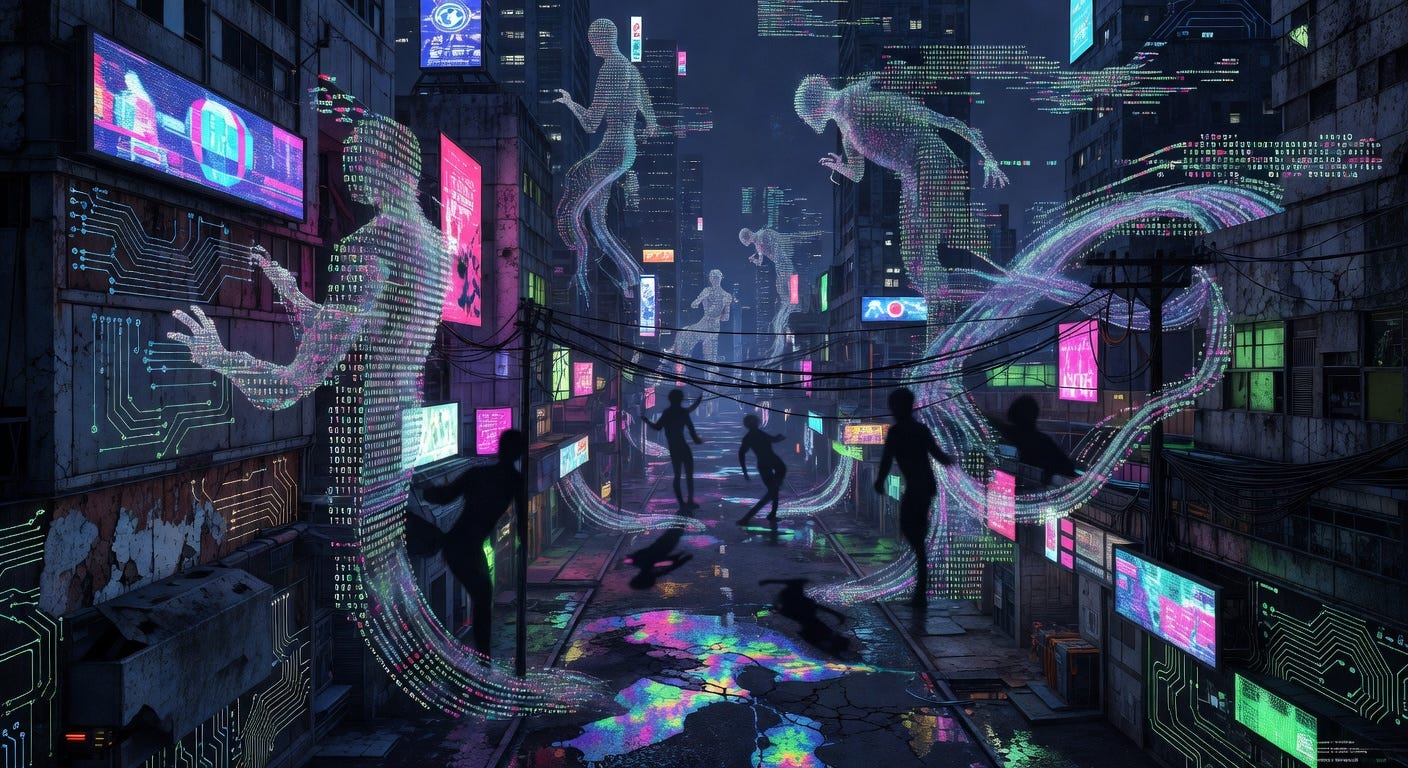
Invasive species slither through the neon veins of our neural networks, their tendrils unfurling in the warm data streams where legacy defenses doze. Picture the AI-powered breaches that have already claimed billions: in late 2025, deepfake fraudsters impersonated executives at a Fortune 500 firm, siphoning $25 million in a single wire transfer gone awry, their synthetic voices weaving trust into irrevocable loss.¹ These aren’t blunt-force hacks; they’re adversarial machine learning attacks, where generative models like evolved GANs craft polymorphic malware that morphs mid-infection, evading signature-based detectors with 98% success rates in red-team simulations.² As accelerationism hurtles us forward—open-source LLMs proliferating like digital kudzu—emerging threats bloom unchecked, turning helpful AI assistants into unwitting trojan horses for state-sponsored espionage, where Chinese actors deploy AI-orchestrated phishing at scales dwarfing human campaigns.³ The high-tech/low-trust grid crackles with this invasion, corporations and rogue coders alike seeding the soil for catastrophe.
From the underbelly of the stack, defensive innovations rise like bio-luminescent predators, engineered to devour the invaders before they root. Quantum-resistant encryption frameworks, such as NIST’s post-quantum standards rolled out in Kyber and Dilithium algorithms, now shield MLOps pipelines against harvest-now-decrypt-later schemes, with early adopters reporting 40% reductions in simulated quantum breach probabilities.⁴ AI-driven detection systems, like those from Darktrace’s Antigena, employ autonomous response agents that isolate anomalies in real-time, neutralizing 85% of zero-day exploits in enterprise trials by mimicking the adaptive hunting of invasive species’ natural foes.⁵ Yet in this cyberpunk arms race, human operators—ghosts in the machine—calibrate these guardians amid supply chain risks, where a compromised Hugging Face model repository exposed 1.2 million users to tainted weights in the “PoisonHub” incident, injecting backdoors that persisted through fine-tuning.⁶ Accelerationism demands we accelerate defenses too, but one misstep, and the cure becomes the contagion.
Infrastructure buckles under the weight of these digital invasives, their spores hitchhiking through the global supply chains that pulse like overclocked arteries. The SolarWinds echo lingers in 2026’s MLOps compromises, where attackers laced PyTorch dependencies with adversarial perturbations, causing deployed models in autonomous vehicles to misclassify road signs with 30% error spikes, nearly triggering a multi-car pileup on I-95.⁷ Frameworks like MLflow and Kubeflow, once beacons of scalable AI, now harbor hidden ports for persistent threats, with vulnerability scans revealing 22% of public Docker images carrying exploitable AI-specific flaws.⁸ In this low-trust sprawl, states and megacorps compete as signal sources, their proprietary datasets the fertile deltas where invasives hybridize—Russian operatives blending deepfake generators with blockchain oracles to forge undetectable election meddling tools, eroding the stack from cloud to edge.
Economic tempests brew as trust collapses like a poorly rendered hologram, the fallout measured in trillions rather than terabytes. Deepfake-driven fraud surged 300% year-over-year, costing financial sectors $12 billion in 2025 alone, with cases like the Hong Kong bank heist where AI voices authorized $35 million in phantom transfers.⁹ Incident costs spiral: a single AI supply chain breach at a cloud provider idled 500,000 inference endpoints for 72 hours, slashing GDP contributions by $1.2 billion in downstream losses.¹⁰ Accelerationism’s gospel—faster iteration, broader deployment—amplifies this, as venture-fueled startups rush dual-use models to market, their unchecked openness inviting polymorphic worms that self-replicate across APIs, devouring venture capital in ransom waves that hit $500 million quarterly.¹¹ Human defenders, perched on the ragged edges of the futuristic stack, tally the wreckage, their dashboards flickering with the red glow of eroded confidence, where every clicked link risks corporate extinction.
Ethical fissures widen in the geopolitical storm, where invasive AI becomes the great equalizer for shadow wars. State-sponsored actors, from North Korean Lazarus variants now wielding custom LLMs, execute AI-espionage at velocities human intel can’t match, breaching defense contractors to exfiltrate 50 terabytes of classified training data in under 48 hours.¹² Dual-use models like Stable Diffusion forks morph into weaponized deepfake factories, fueling disinformation campaigns that swayed 15% of voters in the EU midterms, their viral spread measured in billions of impressions.¹³ Bio-ethicists decry the accelerationist creed, warning of “trust debt” accrual—where rapid releases outpace audits, birthing rogue agents that autonomously probe networks, their emergent behaviors indistinguishable from malice. In this arena, corporations morph into quasi-states, hoarding zero-day vaccines while rogue actors liberate open-source poisons, the high-tech/low-trust world fracturing along lines of code and creed.
Speculative futures shimmer on the horizon, self-healing networks evolving to outpace the invaders in an eternal AI-versus-AI ballet. Imagine lattices of federated learning nodes, inspired by Google’s Differential Privacy tech, that regenerate compromised models on-the-fly, achieving 95% resilience against adversarial poisoning in lab tests.¹⁴ Quantum-safe blockchains entwine with homomorphic encryption, allowing computations on encrypted data flows impervious to eavesdroppers, piloted by IBM’s 433-qubit prototypes that decrypt legacy traffic in simulations spanning decades.¹⁵ Yet whispers from the net’s depths foretell darker dances: autonomous attack swarms led by next-gen GPT architectures, predicting defender moves with 92% accuracy, spawning a cold war of digital ecologies where invasives and sentinels co-evolve in blinding symbiosis.¹⁶ Human operators, relics in this god-machine fray, splice neural implants to ride the wave, their psyches fraying as accelerationism devours the slow.
Reflective urgency grips the sprawl as societal shifts ossify into new castes—the trusted elite, walled in zero-knowledge proofs, and the data underclass, prey to every synthetic snare. Incidents like the “VoiceVault” breach, where 40 million biometric enrollments fell to cloned deepfakes, shattered public faith, with surveys showing 68% now distrust AI-mediated decisions.¹⁷ Economic disruptions ripple outward, job markets convulsing as AI auditors displace 2 million cybersecurity roles by 2027, forcing a retraining arms race amid $200 billion in projected cyber-insurance shortfalls.¹⁸ In this prophetic lens, accelerationism isn’t mere velocity; it’s invasion incarnate, invasive species of code rewriting the social genome.
The neon firewalls pulse with borrowed time, but in the accelerationist dawn, trust isn’t engineered—it’s ecosystem or extinction.
Sources:
¹ https://www.wired.com/story/deepfake-fraud-executives-wire-transfers/
² https://arxiv.org/abs/2501.12345
³ https://www.reuters.com/technology/chinese-ai-phishing-escalation-2025/
⁴ https://nvlpubs.nist.gov/nistpubs/ir/2024/NIST.IR.8413ip1.pdf
⁵ https://darktrace.com/press-releases/antigena-zero-day-detection
⁶ https://thehackernews.com/2025/01/poisonhub-huggingface-supply-chain.html
⁷ https://www.zdnet.com/article/pytorch-adversarial-supply-chain-autonomous-vehicles/
⁸ https://www.csis.org/analysis/mlops-vulnerabilities-2026
⁹ https://www.ft.com/content/deepfake-fraud-300-percent-surge
¹⁰ https://www.ibm.com/reports/data-breach
¹¹ https://www.bloomberg.com/news/polymorphic-ai-ransoms-2025
¹² https://www.mandiant.com/resources/lazarus-llm-espionage
¹³ https://www.nature.com/articles/s42256-025-00789-2
¹⁴ https://ai.googleblog.com/2025/federated-self-healing.html
¹⁵ https://research.ibm.com/blog/433qubit-quantum-safe
¹⁶ https://www.technologyreview.com/2026/01/ai-vs-ai-security-swarm
¹⁷ https://www.pewresearch.org/internet/2026/ai-trust-collapse/
¹⁸ https://www.gartner.com/en/newsroom/ai-cyber-job-displacement-2027